The wonderful world of refinancing

In the current landscape, refinancing is a useful tool for one’s financial journey. People refinance for a variety of reasons.  Many things such as home loans, car loans, student and personal loans can be refinanced. Let us look at what all goes into a refinance.

A refinance, or “refi” for short, refers to the process of revising and replacing the terms of an existing credit agreement, usually as it relates to a loan or mortgage. When a business or an individual decides to refinance a credit obligation, they effectively seek to make favorable changes to their interest rate, payment schedule, and/or other terms outlined in their contract. If approved, the borrower gets a new contract that takes the place of the original agreement. Borrowers often choose to refinance when the interest-rate environment changes substantially, causing potential savings on debt payments from a new agreement.

Consumers generally seek to refinance certain debt obligations in order to obtain more favorable borrowing terms, often in response to shifting economic conditions. Common goals from refinancing are to lower one’s fixed interest rate to reduce payments over the life of the loan, to change the duration of the loan, or to switch from a fixed-rate mortgage to an adjustable-rate mortgage (ARM) or vice versa (in regard to mortgages in particular). Note that during a refinance of a consumer loan (auto, personal, etc.) there are typically no closing costs associated with the refinance process unlike most mortgage loans

Borrowers may also refinance because their credit profile has improved, because of changes made to their long-term financial plans, or to pay off their existing debts by consolidating them into one low-priced loan. Changing interest rates in the economy are moving factors that people look for when shopping around for places to refinance. There must be a new or existing loan for there to be a refinance.

There are several types of refinancing one could take advantage of for their financial situation. One such refinance is a rate/term refinance for a better rate and a more advantageous term for repayment. Another is a cash-out refinance when your auto has more value (commonly referred to as loan to value or LTV) to pull a certain amount of funding against the worth of the vehicle. Another is a cash-in refinance where an individual can place money down to get to their ideal payment, rate, or term. Lastly, one could go for a debt consolidation refinance to help put their payments under one roof and one easy payment.

There are many benefits to a refinance such as lower payments, rates, and terms. Additionally, there is the convenience of consolidation of payments and an influx of cash for cash-out refinancing requests. There are some drawbacks to a refinance. One such drawback is if there is a movement back to the original term there is more interest to be paid during the life of the loan, shortened terms may increase payment potentially as well. If interest rates drop, you won’t get the benefit with a fixed-rate mortgage unless you refinance again and you could lose equity in your home depending on the mortgage refinance.

Refinancing is a powerful tool that can benefit you in the long run if done correctly. During my time in finance, I have seen many practical applications of refinancing that people use to their advantage. Until the next time dear readers, excelsior!
Debts vs income

From a credit perspective any things can be weighed in to determine how a lender can look at to determine eligibility for a loan. One such variable is what is called the debt-to-income ratio. This ratio is something that can determine your inflow vs outflow of money that you use for paying any debtor.

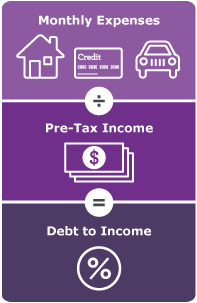
The debt-to-income ratio (commonly referred to as DTI ratio for short) is the percentage of your gross monthly income that goes to paying your monthly debt payments and is used by lenders to determine your borrowing risk. A low DTI ratio demonstrates a good balance between debt and income, while a higher ratio determines there is more going on behind the scenes.  The maximum DTI ratio varies from lender to lender. However, the lower the debt-to-income ratio, the better the chances that the borrower will be approved, or at least considered, for the credit application.  An ideal formula for determining DTI would be to divide the number of the total monthly debt payments (credit cards, loans, mortgages, rent etc.) over the total of gross monthly income (your income before tax and deductions). For example, if john owes $1200 in his monthly bills and his gross income is $2700 per month his overall DTI would be $1200/2700=0.44 or 44%. John has a more moderate debt to income ratio based on these figures.

Calculate Your Debt-to-Income Ratio – Wells Fargo

One can lower their debt-to-income ratio by reducing their monthly recurring debt or increasing their gross monthly income. Using the above example, if John has the same recurring monthly debt of $2,000 but his gross monthly income increases to $8,000, his DTI ratio calculation will change to $2,000/$8,000 for a debt-to-income ratio of 0.25 or 25%. Similarly, if John’s income stays the same at $6,000, but he can pay off his car loan, his monthly recurring debt payments would fall to $1,500 since the car payment was $500 per month. John’s DTI ratio would be calculated as $1,500/$6,000 = 0.25 or 25%. If John can both reduce his monthly debt payments to $1,500 and increase his gross monthly income to $8,000, his DTI ratio would be calculated as $1,500/$8,000, which equals 0.1875 or 18.75%. Ideally renegotiating interest rates, aggressive payment schedules including principal payments and generating more income through a second job or a side gig for other active or passive income are some ways that people have taken to rapidly clear up debt and improve their ratios

The DTI calculation in assessing the risk that a borrower poses to a lender in terms of their ability to repay. The lower their ratio (such as 35% or less as noted by an average between different lending companies and financial institutions) can be considered more favorable. Meanwhile a DTI of 36-49% leaves room for improvement and can be steered into a more manageable direction with proper education and action plans. For a DTI above 50% it is generally considered difficult for a borrower or spend or save as their money for unforeseen circumstances. The higher the DTI the more likely a borrower could be inversely impacted by any major financial event and presents more of a risk of default to a lender. The ideal situation for a customer and a lender is to be at a point where any new debt ought not to put the borrower or the organization doing the lending in an adverse situation that would harm the institution with a loss or damage an individual’s credit.

The Debt-to-income ratio is a commonly questioned concept for credit building and lending by consumers. I hope my summary of what DTI is and how it affects you will give you more insight to how to further gain more perspective on your own credit journey. For your convenience I have also included a link for a DTI calculator for you to plug and play with figures to see how your own DTI is faring. Until the next time dear readers. Excelsior!

How to use a check

In this age of modern technology the process of carrying a card is commonplace. We are moving away from the days of carrying cash and using checks. In light of this transition, i have elected to share with you the proper way to utilize a check. This would be review to some but for others this will be a new topic for you. The goal behind this is to keep you informed on how to use some of the older financial transactions in the wake of this shifting dynamic in personal finance. Just in case any of our newer methods fail us you’ll know how to use a check if necessary.

How to use a check

example


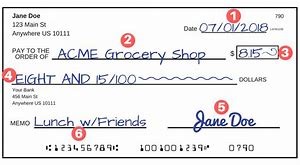
  1. Date line: date goes here
  2. Name of the writer of the check aka the payee line
  3. Numerical value of the amount of the check aka courtesy box
  4. The hand written amount of the check aka the legal line
  5. Signature line: signature of the payee goes here
  6. Memo line: optional note (what the check is fore i.e. groceries, reimbursement etc.)


Using the check

You can make use of a check by signing the back of it aka endorsing the check

You have several types of endorsements

For deposit only- restrictive

The name of the payee- blank

Pay to the order of – special endorsement


Dos and don’ts

Do make sure that the legal line and the courtesy box amounts match (a check wrote for $100 on the courtesy box must match the legal line amount. If a check is wrote for $10 on the legal line but in the courtesy box it looks wrote for $100 it must be taken for the LEGAL LINE amount of $10


Do sign your check at the place you intend to deposit or cash because if you lose it another person can endorse their name under yours and use the check (unless it is a special endorsement where it has to be pay to the order of a specific person)


Don’t write in different types/color of pen on the face of the check. That will alter the check and can cause the check to be refused

Do not write a check for “cash” if it is lost it can be used to be cashed by anyone

Make sure you have a signature under the signature line from the person writing the check otherwise it will not be utilized

Do not leave your checks out in the open because they have your account and routing number info there. Keep them in a safe place for storage.

Keep in mind that a check can be placed on hold if deposited or cashed depending on the institution or if put into an ATM

Do keep a consistent signature on your checks because signature fraud happens

Do get duplicate style checks; the carbon copy underneath the check will make balancing your check book easier

Do make sure you don’t damage your check in any way especially near the numbers at the bottom of the check because it will make using it harder

Do always write a check with a pen so no one can alter it

Do not leave your checks blank (not filling out a payee line) because it increases the risk of fraud with the check

Do make sure to balance your checkbook regularly to avoid discrepancies and running the risk of bouncing a check


With this you know have the basics of how to use a personal check. Stay tuned for other tips and tricks on navigating the fun world of personal finance


Photocredit: the balance.com