Aging like fine wine

Building credit takes time. As I often tell my clients: credit building is a marathon rather than a sprint. The age of credit is an often misunderstood concept as in today’s fast paced society it is something that can be very important to improve credit history.

The average age of accounts is one of the factors that contribute to your overall Length of Credit History, which itself accounts for 15% of your total FICO credit score. This is calculated as a simple, non-weighted average; it’s the sum of the ages of your credit accounts divided by the number of accounts that you hold. These are also ranked in importance: the age of your oldest account, average age of accounts, and age of your newest account.

When you close a credit card, it can stay on your credit report and continue to age for 10 years. This means that you could open a credit card today, cancel it tomorrow, and 9 years from now, it would still show up on your credit report and contribute to your credit history.

An example of this would the average of your credit cards. Card 1 is 7 years old, card 2 is 3 years old and card 3 is 2 years old. We could take the average between the 3 cards to obtain an average age of 4 years between all credit cards. If you close one of the cards and fast forward 10 years card number 1 is now 17 years old, card 2 is 13 years old and card 3 is 12 years old. Taking your average age of accounts to 14 years old. This can still be in effect due to credit card accounts lingering on your credit report can still effect your history for up to 10 years. The most important concept to remember is not to close the longest (oldest) open trade as this will hurt your average age of your accounts and your credit score. Closing the newer cards will have less of an impact due to them being newer, but it is important to remember when closing a credit card that there is credit capacity (amount of available credit vs amount of credit used) that is lost when this happens. If the capacity is reduced thus will also hurt your score if your balances are too high on your remaining cards. Only close out credit accounts as needed (if they’re not installment loans of course).

Credit utilization can be tricky but if one knows how to navigate the complexities it can be a rewarding tool. Letting time work it’s magic on your open credit accounts cab do wonders for your score. Until the next time dear readers excelsior.

The wonderful world of refinancing

In the current landscape, refinancing is a useful tool for one’s financial journey. People refinance for a variety of reasons.  Many things such as home loans, car loans, student and personal loans can be refinanced. Let us look at what all goes into a refinance.

A refinance, or “refi” for short, refers to the process of revising and replacing the terms of an existing credit agreement, usually as it relates to a loan or mortgage. When a business or an individual decides to refinance a credit obligation, they effectively seek to make favorable changes to their interest rate, payment schedule, and/or other terms outlined in their contract. If approved, the borrower gets a new contract that takes the place of the original agreement. Borrowers often choose to refinance when the interest-rate environment changes substantially, causing potential savings on debt payments from a new agreement.

Consumers generally seek to refinance certain debt obligations in order to obtain more favorable borrowing terms, often in response to shifting economic conditions. Common goals from refinancing are to lower one’s fixed interest rate to reduce payments over the life of the loan, to change the duration of the loan, or to switch from a fixed-rate mortgage to an adjustable-rate mortgage (ARM) or vice versa (in regard to mortgages in particular). Note that during a refinance of a consumer loan (auto, personal, etc.) there are typically no closing costs associated with the refinance process unlike most mortgage loans

Borrowers may also refinance because their credit profile has improved, because of changes made to their long-term financial plans, or to pay off their existing debts by consolidating them into one low-priced loan. Changing interest rates in the economy are moving factors that people look for when shopping around for places to refinance. There must be a new or existing loan for there to be a refinance.

There are several types of refinancing one could take advantage of for their financial situation. One such refinance is a rate/term refinance for a better rate and a more advantageous term for repayment. Another is a cash-out refinance when your auto has more value (commonly referred to as loan to value or LTV) to pull a certain amount of funding against the worth of the vehicle. Another is a cash-in refinance where an individual can place money down to get to their ideal payment, rate, or term. Lastly, one could go for a debt consolidation refinance to help put their payments under one roof and one easy payment.

There are many benefits to a refinance such as lower payments, rates, and terms. Additionally, there is the convenience of consolidation of payments and an influx of cash for cash-out refinancing requests. There are some drawbacks to a refinance. One such drawback is if there is a movement back to the original term there is more interest to be paid during the life of the loan, shortened terms may increase payment potentially as well. If interest rates drop, you won’t get the benefit with a fixed-rate mortgage unless you refinance again and you could lose equity in your home depending on the mortgage refinance.

Refinancing is a powerful tool that can benefit you in the long run if done correctly. During my time in finance, I have seen many practical applications of refinancing that people use to their advantage. Until the next time dear readers, excelsior!

Debt vs income part 2: the less secure edition

Last time we discussed what the debt to income ratio was and how it effects one’s overall financial picture. This time we will discuss another ratio that effects your financial picture. The unsecured debt to income ratio is another important piece to understand your financial situation.

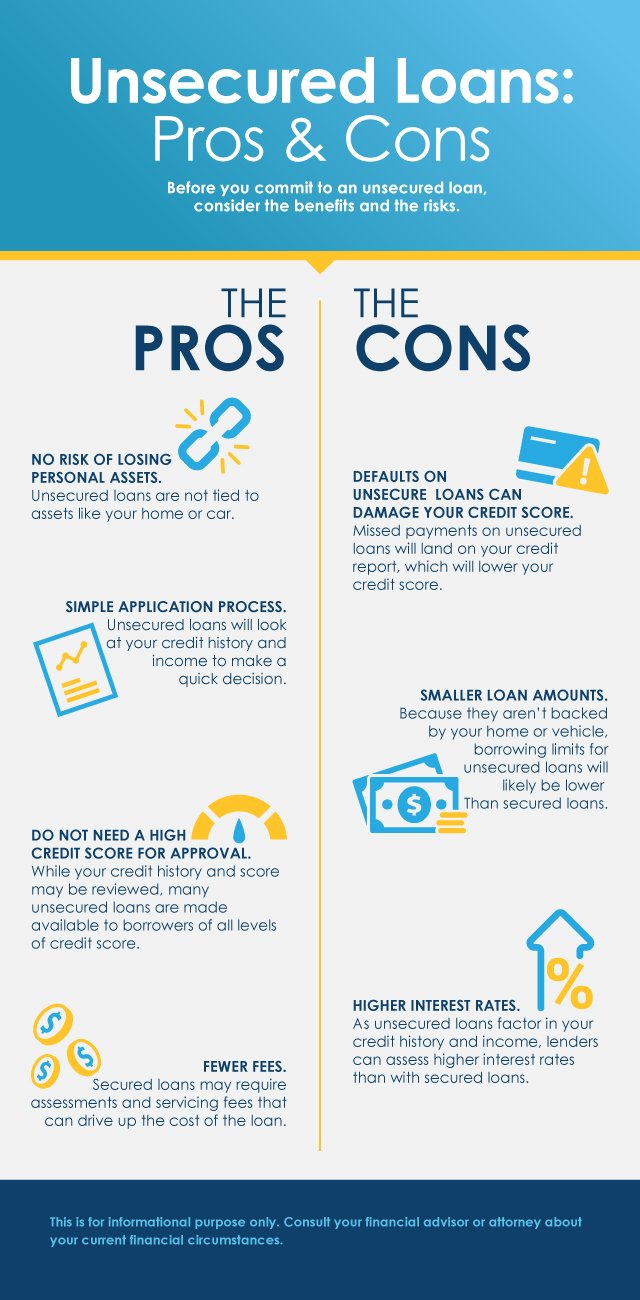
Unsecured debt is different from a secured debt as the debt isn’t tied to a piece of collateral such as a car or house. Types of unsecured debt would be credit cards, personal loans, lines of credit, etc. As such these debts are typically assessed higher interest rates than secured debt because of the risks associated with them in the event of a default of payment from a borrower or bankruptcy risk if the borrower ventured into this route.

The unsecured debt ratio (UDTI) equals the total of unsecured debt divided by the total annual income, multiplied by 100, which converts it to a percentage. For example, say Sarah carries $8,000 of credit card debt, $12,000 in personal loans and her annual income is $80,000. Divide the total unsecured debt of $20,000 by $80,000 to get 0.25. Then, multiply 0.25 by 100 to find that Sarah has an unsecured ratio is 25 percent. If Sarah increases her unsecured debt load her and her income remains the same her UDTI will increase. In the opposite scenario if Sarah’s income increases or her unsecured debt is paid down more her UDTI decreases.

Lenders don’t like to make additional unsecured loans to people with high existing unsecured ratios because that’s tacking on additional debt to someone who’s already overextended. Financial institutions often see unsecured ratios of above about 20% as potentially dangerous. When someone gets above 20 percent, the prospective lender might lower the amount it will lend or require the borrower to put up collateral. If the borrower exceeds 30 percent, they will likely encounter trouble just getting an unsecured loan, because lenders are concerned with the ability to repay and there is more risk associated with lending unsecured vs secured. It is ideal to be in a range that is reasonable for a borrowers existing debt and income level and to go beyond that could indicated many factors such as living off of credit cards and unsecured debt to a point where eventually it leads to an eventual endpoint of defaults, garnishments or legal actions to recoup losses from a borrower or even bankruptcy filled by a borrower who is unable to pay. None of which are a desirable outcome for the institution or the borrow to end up.

The unsecured debt to income ratio is an important snapshot of one’s financial picture in the eyes of a lender. It is important to know how it can help or hurt your overall credit and financial situation. I have included a link to assist in calculating your unsecured debt to income ratio as well. Please uses these tools to help with understanding where you are with your own debts to gain a firm grasp on what was covered today. Until the next time dear reader. Excelsior!

Debts vs income

From a credit perspective any things can be weighed in to determine how a lender can look at to determine eligibility for a loan. One such variable is what is called the debt-to-income ratio. This ratio is something that can determine your inflow vs outflow of money that you use for paying any debtor.

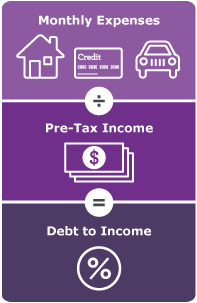
The debt-to-income ratio (commonly referred to as DTI ratio for short) is the percentage of your gross monthly income that goes to paying your monthly debt payments and is used by lenders to determine your borrowing risk. A low DTI ratio demonstrates a good balance between debt and income, while a higher ratio determines there is more going on behind the scenes.  The maximum DTI ratio varies from lender to lender. However, the lower the debt-to-income ratio, the better the chances that the borrower will be approved, or at least considered, for the credit application.  An ideal formula for determining DTI would be to divide the number of the total monthly debt payments (credit cards, loans, mortgages, rent etc.) over the total of gross monthly income (your income before tax and deductions). For example, if john owes $1200 in his monthly bills and his gross income is $2700 per month his overall DTI would be $1200/2700=0.44 or 44%. John has a more moderate debt to income ratio based on these figures.

Calculate Your Debt-to-Income Ratio – Wells Fargo

One can lower their debt-to-income ratio by reducing their monthly recurring debt or increasing their gross monthly income. Using the above example, if John has the same recurring monthly debt of $2,000 but his gross monthly income increases to $8,000, his DTI ratio calculation will change to $2,000/$8,000 for a debt-to-income ratio of 0.25 or 25%. Similarly, if John’s income stays the same at $6,000, but he can pay off his car loan, his monthly recurring debt payments would fall to $1,500 since the car payment was $500 per month. John’s DTI ratio would be calculated as $1,500/$6,000 = 0.25 or 25%. If John can both reduce his monthly debt payments to $1,500 and increase his gross monthly income to $8,000, his DTI ratio would be calculated as $1,500/$8,000, which equals 0.1875 or 18.75%. Ideally renegotiating interest rates, aggressive payment schedules including principal payments and generating more income through a second job or a side gig for other active or passive income are some ways that people have taken to rapidly clear up debt and improve their ratios

The DTI calculation in assessing the risk that a borrower poses to a lender in terms of their ability to repay. The lower their ratio (such as 35% or less as noted by an average between different lending companies and financial institutions) can be considered more favorable. Meanwhile a DTI of 36-49% leaves room for improvement and can be steered into a more manageable direction with proper education and action plans. For a DTI above 50% it is generally considered difficult for a borrower or spend or save as their money for unforeseen circumstances. The higher the DTI the more likely a borrower could be inversely impacted by any major financial event and presents more of a risk of default to a lender. The ideal situation for a customer and a lender is to be at a point where any new debt ought not to put the borrower or the organization doing the lending in an adverse situation that would harm the institution with a loss or damage an individual’s credit.

The Debt-to-income ratio is a commonly questioned concept for credit building and lending by consumers. I hope my summary of what DTI is and how it affects you will give you more insight to how to further gain more perspective on your own credit journey. For your convenience I have also included a link for a DTI calculator for you to plug and play with figures to see how your own DTI is faring. Until the next time dear readers. Excelsior!

Credit utilization

A common tactic utilized to build a credit history is typically acquiring a credit card of some sort. this along with other credit building programs begins one’s journey for getting into a more favorable credit range. Credit card usage is a factor that helps with establishing a score, but there are things about the usage that one must know.

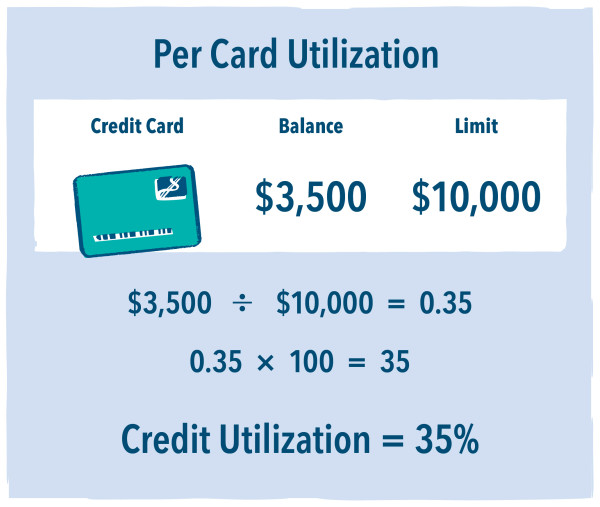
A credit card is a revolving tradeline (a trade line that when it is used and repaid you acquire a certain amount of the credit back). Credit cards have a capacity of use that displays how much of the overall limit has been used in a specific period. Credit utilization measures the balances you owe on your credit cards relative to the cards’ credit limits. If you never use your credit cards and there’s no balance on them, your credit utilization would be zero. If you typically carry a balance on one or more cards, you are ‘utilizing’ some of your available credit and credit score providers will take note. Credit utilization is a key piece of your credit score puzzle. Both FICO and Vantage, two big credit scoring agencies, list credit utilization as the second highest factor they consider when determining credit score. If your utilization ratio is high, it indicates that you may be overspending and that can negatively impact your score. This utilization ratio, as a rule of thumb, is recommended to be around 30 percent or less and is calculated by the total amount of card balances vs the amount of available credit. This means not maxing out existing credit cards. This utilization ratio can be improved by a variety of methods including, but not limited to; paying down current debt past the minimum payment, consolidation of credit card debts, getting another credit card, getting a credit limit increase, or leaving open existing cards once they’re paid amongst other methods.

How Does Credit Utilization Work?

Now that you know how to improve your credit utilization, it’s important to keep track of your progress. Check your credit card balances monthly and keep tabs on your utilization ratios. Many card issuers offer balance alerts via text or email, making it even easier to prevent your utilization ratio from creeping up. Monitoring your credit score can also provide motivation to keep your utilization in check. This was a short lesson, but vital nonetheless. Until the next time dear reader. Excelsior!

Collect call

What Happens If You Don't Pay a Debt Collection

Dealing with credit can be tricky, there are different types of factors that build your credit and factors that hurt it. One such factor that hurts your score is having collections out against you. Collections are oftentimes neglected and can come back around in the future.Did you know that 71 million Americans have collection debt of some sort or another? (courtesy of urban.org)

Collections come from when a loan or bill has gone unpaid or was charged off/ listed as a loss on a company’s profit and loss statement and is given over to a collection agency. The collection agency then goes to contact you to collect the debt to be paid off. Once the collection is paid then it is cleared from the book of the collection agency and is reflected on your credit report if it is paid off. The same applies if a bill is listed as a collection on your credit report.

In my field of expertise, I have come to know that letting collections sit is not conducive to a healthy credit rating and can serve as an annoying anchor weight stopping your credit from reaching new heights. It is imperative to get rid of collections as soon as they are discovered or If something is going towards collections. Even if a bill disappears somehow and it was not paid there could be a chance it was sent to a collection agency to pester you to get their payment. These are not to be taken lightly. Even if a collection is paid it remains on a credit report for seven years but despite this, it could show that it was paid and prevent a collection agency from bothering you about the same debt. This is because a collection agency has seven years to collect this debt before they lose their chance to get paid. If it is coming down to the wire the collection agency can sell this debt to another agency and the “doctor’s bill from 10 years ago” could be lurking around for the next 20 years! Like dirt under a rug, it is waiting to be disturbed and make a mess again.

Collections can hurt your FICO credit score, contrary to a commonly held belief I have come across in my time in the field and research. The claim is that when updated from “unpaid” to “paid,” the collection can appear to the scoring formula as having originated more recently than it did, which, if true, could lower the score. However, the “assigned” date on the credit report does not change when the collection status is updated, nor do the credit scoring formulas give fewer points for a paid than an unpaid collection. Due to the length of time since the debt was assigned to a collection agency weighs so heavily on a credit score, the removal of the most recent collections can often be expected to raise a score. On the other hand, if there are multiple collections and it’s the older ones that you’re able to get removed, such as via a “pay for delete,” you may not see any improvement in your score following the removal of these older collections. So there is no evidence to support the myth that paying a collection can lower a score.

Collections can happen to anyone, whether you are already managing your credit responsibly or have hit hard times financially. Separating the facts from the fallacies about collections and credit scores can help you make more of the right moves and avoid some of the bad ones that can have an undesirable result. One way to check on the impact a collection might be having on your credit is to obtain your credit report from your bank, credit union, or from even the bureaus themselves. You can also go to sites like annualcreditreport.com to get your report for free as well. Do not let collections sneak up on you, something that might seem insignificant can still have an impact in the long run. Until the next time friends, excelsior!  

In your best interest

Interest Rate Definition

You hear about it, you probably pay it, you probably get paid in it. Love it or hate it we are going to talk about interest, what it is and how to make sense of it. Interest is a simple concept but there is often misconceptions about it and confusion. Let us get started in debunking that confusion.

Interest is payment from a borrower or deposit taking institution (such as a bank) to either a lender (someone who you took out a loan from) or a depositor (someone who puts money in the bank) above the principal sum (the original amount of the loan or deposit).at a particular rate. It’s not like a fee which gets paid to a lender and it is not like a dividend that is paid to a shareholder. When interest is paid to a lender or a person depositing money in an interest-bearing account more money comes out on the principal balance. The rate of interest  is equal to the interest amount paid or received over a particular period divided by the principal sum borrowed or lent usually expressed by a percentage (such as the annual percentage rate for loans or average percentage yield on interest bearing savings). Wen dealing with interest you also have compound interest (this is the fun one to get paid but not so fun if you are the one paying) which makes the total amount of the debt grow. Interest can be compounded daily, monthly, or on a yearly basis and the impact is affected by the compounding rate.

When dealing with interest you have some rules of thumb to consider. First, the rule of 78s which helps with calculating interest during the life of the loan as you pay on it. (i.e. on a 1 year loan in the 1st month 12/78 of all interest owed over the life of the loan is due and so on and so forth until the 12th month where only 1/78 of all interest is due. The rule of 72 can be used to approximate how long it would take for money to double at a given interest rate, for the compounding interest to reach or exceed the initial deposit, divide 72 by the percentage interest rate. When dealing with interest you always have options to refinance as well as find interest bearing accounts for higher interest to be paid. There are more technical aspects to interest as one looks into the markets and economics outside of the simple aspects of getting pair or paying interest but that is a topic for another time.

Until the next time, stay safe and continue to learn. Excelscior!

The truth behind debit cards

As times change, technologies change, and we develop things to help make our lives easier and more convenient. One such example is the introduction of the debit card. This handy little piece of plastic eliminates the need to carry cash but, like anything else in life, it has its pros and cons. We will look at how debit cards work and some myths and facts about them as well.

Image result for debit card transactions

Debit cards are primarily tied to your checing account for purchasing. You can also access funds at the ATM with your debit card as well. There are multiple parts in a debit card transaction, and we’ll break down how the process works. When someone swipes a debit card through a merchant’s terminal, the terminal reads the magnetic stripe (or chip) in the card and transmits the data to a card processing network, this is called authorization. There are several card processing networks commonly found on the emblem on your card (Visa, MasterCard, star network, maestro, etc.).  The network ensures the pieces of transaction data are correctly formatted. Then, it performs a fraud analysis and forwards the information to the bank that issued the debit card. The issuer then validates that the card hasn’t been reported as stolen or lost, confirms whether funds are available in the cardholder’s account and then notifies the merchant, again through the network, whether the transaction has been approved.

Image result for debit card processing

Once authorized, the card transaction will need to be sent through the card processing network to be sent through to their bank. This might take several tries throughout the day, once sent through the transactions are recompiled and sent to the issuers. Once this is done the issuer posts the transaction to the customer’s account. That’s what is called clearing the transaction. Once cleared, the network will calculate how much the issuer owes the merchant and vice versa and payment is made. This could be done on the same day, next day or several days. Once the merchant is paid by the acquiring financial institution and the network is paid the transaction is settled.

Your 16-digit card number on your debit card is crucial in the transaction process. Typically, the 16 digits are comprised of a 6-digit bank verification number (to identify your issuing bank) to help verify the account being debited. The back of the card carries a magnetic stripe, signature panel or a code or a chip. Sometimes the issuer of the card will put a hold onto the funds on the card being used until the transaction is authorized and the transaction settles. To illustrate I have two examples of this: An authorization to purchase gasoline up to a certain dollar amount might be adjusted after the fuel is pumped into the tank, and an authorization to pay a certain dollar amount for a meal at a restaurant might be adjusted after the diner adds a tip to the total. This is what causes transactions to sometimes “disappear and reappear” on your transaction history on your accounts.

Image result for pin based transaction

Visa and MasterCard tend to process signature-based transactions, which typically use a so-called two-message process in which authorization and settlement are performed separately. The smaller networks usually handle PIN-based purchases, which occur via a single message that incorporates both authorization and settlement. Signature transactions are more widely accepted by different merchants while pin transactions are typically found at major retailers, gas stations and supermarkets. But as times go on the distinction between pin and signature transactions gets more intertwined with more places being more “swipe and go” and pin-based charges not needing a pin or a signature transaction not needing a signature.

Image result for disputing debit card transactions

Oftentimes there is confusion about debit card transactions on an account. When you look at your statement, the transactions down with a debit card may show up as POS transactions, with the merchant listed on the account. If you see an ACH transaction, this means that the money was directly debited from your account and that you did not use your debit card to complete your transaction. Understanding this can help you if you are trying to find out if someone accessed your account without your permission. It can also help you identify spending if something is not labeled correctly. For example, your local fast-food restaurants may be doing business under another name.
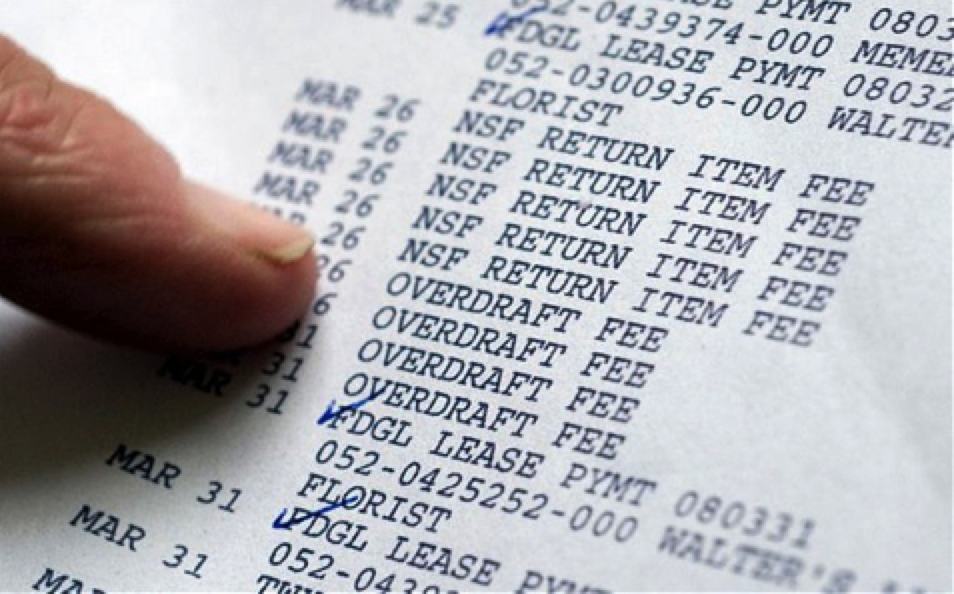
Image result for overdrafting account

You can overdraw your account with a debit card. Some banks allow you to overdraw your account to a certain dollar amount and simply charge you fees for each transaction that they pay into the negative. Additionally, if you have checks clear later that night, you can find yourself overdrawn while using your debit card. It is important to keep a running balance on the account so that you know how much money you have available to you. Some charges may drop off the hold before they clear your account. It makes the money available again, which means that you can overdraw your account while using a debit card. Additionally, a check may not have cleared, which allows you to overdraw. Tracking your purchases yourself on paper or with an app is the best way to protect your money.

One of the biggest precautions you need to take with your debit card is to make sure that it or the information on it is not stolen. If your card is physically stolen, you need to call the bank immediately and cancel the card. Criminals might hack a website and steal the card information and then use it to make purchases online. Your bank may have sent you a new debit card at some point because there was a data breach at a merchant. If you find unauthorized transactions in your account, you need to call the bank immediately to find out what happened.

Another way that criminals are getting the information is through card skimming (one of the different types of fraud I discussed in my previous post on fraud.  The person can either swipe your card through the machine themselves (this happens at restaurants or other places where they take your card from you momentarily) or they can attach a skimmer to a machine where you use your card (like an ATM, vending machine, or RedBox). The skimmers are very small and blend in well. They can be difficult to spot. However, if one of these looks off to you, especially where you swipe the card, you should likely use a different ATM or vending machine. It is important to check your account regularly and watch out for unauthorized transactions, because the sooner you spot the problem, the easier it will be to resolve.

Debit cards are handy tools that can be used to may your day to day business as paper-free as possible. There are pros and cons to utilizing one and now with the knowledge of how these cards work, you can now operate with a better insight as to how these cards work and what all goes into each transaction. That is all I have for today, until the next time, invest wisely my friends.