
What is a line of credit?

As a finance professionL I am asked a myriad of different questions in regards to personal finance. From simple questions on account balances to the fine workings of credit, there is never a dull moment or a dull question. One common misconception I have seen is what a line of credit is and exactly how it works.

A line of credit is a revolving line of credit (similiar to a credit card) that allows you to access money as you need it up to a certain limit. You can borrow up to that limit again as the money is repaid over time. A line of credit requires approval by a bank or credit union through various criteria such as credit, income, and other factors that a lender may require. Once funds from a line of credit are used, interest will accrue until the loan is repaid.

Unlike traditional personal loans (and most credit cards), the interest rate on a line of credit is generally variable, meaning it could change as broader interest rates change. This can make it difficult to predict what the money you borrow will end up costing you over time.

Generally speaking, lines of credit aren’t as common as their counterparts know as home equity lines of credit or HELOCS (we’ll visit this later). These see usage for various things such as home improvement projects, weddings, unexpected repairs, and other things that might not have a certain upfront cost. Additionally, there may be other costs associated with the line of credit, such as maintenance fees. Be sure to consult your lender in regards to learning all fees associated with a line of credit. Credit cards will always have minimum monthly payments, and companies will significantly increase the interest rate if those payments are not met. Lines of credit may or may not have similar immediate monthly repayment requirements.

In summary, lines of credit are useful tools that can benefit you if there are things that are appropriate to use it for. They aren’t common, but whether it be for a person or for a business, a line of credit can be a viable asset to move things along. Until the next time dear readers. Excelsior!

Aging like fine wine

Building credit takes time. As I often tell my clients: credit building is a marathon rather than a sprint. The age of credit is an often misunderstood concept as in today’s fast paced society it is something that can be very important to improve credit history.

The average age of accounts is one of the factors that contribute to your overall Length of Credit History, which itself accounts for 15% of your total FICO credit score. This is calculated as a simple, non-weighted average; it’s the sum of the ages of your credit accounts divided by the number of accounts that you hold. These are also ranked in importance: the age of your oldest account, average age of accounts, and age of your newest account.

When you close a credit card, it can stay on your credit report and continue to age for 10 years. This means that you could open a credit card today, cancel it tomorrow, and 9 years from now, it would still show up on your credit report and contribute to your credit history.

An example of this would the average of your credit cards. Card 1 is 7 years old, card 2 is 3 years old and card 3 is 2 years old. We could take the average between the 3 cards to obtain an average age of 4 years between all credit cards. If you close one of the cards and fast forward 10 years card number 1 is now 17 years old, card 2 is 13 years old and card 3 is 12 years old. Taking your average age of accounts to 14 years old. This can still be in effect due to credit card accounts lingering on your credit report can still effect your history for up to 10 years. The most important concept to remember is not to close the longest (oldest) open trade as this will hurt your average age of your accounts and your credit score. Closing the newer cards will have less of an impact due to them being newer, but it is important to remember when closing a credit card that there is credit capacity (amount of available credit vs amount of credit used) that is lost when this happens. If the capacity is reduced thus will also hurt your score if your balances are too high on your remaining cards. Only close out credit accounts as needed (if they’re not installment loans of course).

Credit utilization can be tricky but if one knows how to navigate the complexities it can be a rewarding tool. Letting time work it’s magic on your open credit accounts cab do wonders for your score. Until the next time dear readers excelsior.

Inquiring minds

In the world of credit there are many different factors that build and tear down a score. One common conversation I often have in regards to credit is regarding inquiries. There are many misconceptions as to what an inquiry is and I will explain and debunk these misconceptions in this post.

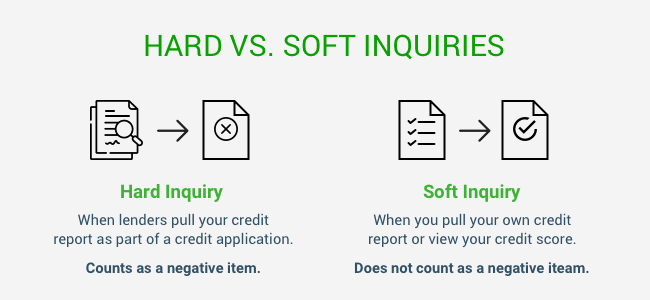
Inquiries are entries that appear on your credit report when your credit information is accessed by a legally authorized person or organization (including yourself). Most commonly, inquiries are the result of an application for credit, goods or services, an account review made by a company that you already do business with, or a preapproved offer of credit that has been sent to you.

There are two types of credit inquiries: hard inquiries and soft inquiries. Account reviews and preapproved offers fall under the category of soft inquiries, which have no effect on your credit scores. Hard inquiries include applications for credit or certain services, and although their impact is minimal, they can temporarily affect your scores. It is good practice to get your credit report checked throughout the year to view hard and soft inquiries.

A hard inquiry appears on your credit report when a lender checks your credit in response to an application for a new loan, credit card or line of credit. Whenever you seek new credit, there’s the potential for a new debt, which may temporarily lower scores slightly until you can show that you are managing that new debt responsibly. Credit scoring models such as those from FICO or Vantage sometimes account for that increase in risk by lowering your scores slightly. Typically, most score models show hard inquiries typically lowering scores by less than five points.

Hard inquiries remain on your credit report for up to two years, but as long as you keep up with your payments, credit scores often rebound from an inquiry within a few months. And, most credit scoring models no longer count a hard inquiry in score calculations at all after 12 months.

Soft inquiries appear on your credit report when someone runs a credit check for reasons unrelated to lending you money. These events are not associated with greater repayment risk, so they have no effect on your credit scores. Common examples include but are not limited to: utility companies for services and equipment, auto insurance companies, credit card companies that you have accounts with currently, as well as a credit review with a lender in a bank or credit union.

It is ideal not to accumulate too many inquiries as they can lower your scores over time if one is rapidly shopping for credit. There are an exception to this however. If there are multiple inquires from a car dealership to other lenders when you finance a car (this is called shotgunning the credit as it goes to mulltiple lenders) within a certain period of time it is counted as one inquiry. Inversely, if there are multiple inquires foe different types of credit in a period of time that is a sign of concern to a lender. It is important to check your score reports at least once a year to ensure all inquires on your report were authorized as unfamiliar inquiry activity could be a sign of either an error or criminal activity. You can review your annual credit report for free Here.

Inquiries are as I call the “cost of admission to credit”. These inquires make up a small percentage of your credit score but it is important to not go overboard with shipping for credit and recognize that even if they are small, inquires can still have an effect on your credit score. Until the next time dear readers, excelsior.

How sufficient is your credit?

A message on a credit report that can pop up is “insufficient credit”. This is a message commonly found for those who are young, operated primarily with buying things cash, or perhaps haven’t taken out a form of credit in a very long time. This isn’t necessarily a good or bad thing, but rather a good launching point towards developing health credit.

When applying for credit, lenders are only allowed to use a specific set of criteria to evaluate an application. Insufficient credit history indicates that the applicant doesn’t have enough accounts with a long enough payment history to approve an application. Banks, cell phone companies, and utility companies also look at this information when you set up a new account. As an applicant applies for bigger loans, lenders want to see that an applicant can handle multiple accounts responsibly. If someone only has a single credit card or too few accounts overall this could be a reason for rejection on a credit application.

On the other side of the coin, one wouldn’t want to go opening too many new accounts in a short time to build credit. On average it takes a minimum of 6 months for a new trade to make progress on an individual’s credit rating. Opening too many would be classified as an escalation of new debt. This could also be a reason to deny an applicant on a credit application. On another note, if there isn’t an update in activity (such as a credit limit increase or a new line of credit) for a substantial period, an individual’s credit could become stale and outdated causing it to be insufficient again. Keep in mind that the age of active credit lines also helps in building a score over time. These trades could be a line of credit or a credit card primarily.

Updating the personal information in one’s credit history is relatively easy. Building up one’s credit history takes more time and credit experts emphasize that there is no quick fix to a credit score. Experts typically recommend a few ways to help keep things in a positive light for one’s credit: 1) pay all bills on time to avoid them going into a collection action 2) opening a secured credit card or secure loan of some sort to start a history 3) reporting non-debt obligations If your lender uses a scoring system that counts that among other ways. Some lenders will overlook an insufficient credit history if the applicant is strong in other areas such as in debt-to-income ratios and stable proof of income to show how one could make payments.

Keep in mind that another common misconception is that checking accounts, debit cards and credit union accounts do not build credit. The checking account is designated for expenses and the debit card can be run as “credit” but is not truly linked to a credit line. Credit union accounts give you access to the credit union and all its services such as lending and credit building programs.   

Having insufficient credit can be difficult and confusing at times, but it doesn’t have to be. Feel free to reach out to your local financial experts at your financial institution and ask for ways to help establish a credit history for yourself. It will take time but the result of a healthy score and better rates are worth it. Until the next time dear readers, excelsior!