Streams of flowing income

What is Multiple Streams of Internet Income (MSII)? Why is it important to  have MSII? – The Internet Income Academy

This time a year ago the entire world was turned upside down by a pandemic. Lockdowns ensued and people lost jobs, lives, and there was so much panic and confusion and uncertainty. Fast forward a year later and we are still feeling the effects of this ongoing issue in every way possible. One of the lessons that cannot be emphasized enough is the need for an alternative stream of income in the even one stream dries up there are others to keep funds flowing through into your accounts.

There are several different types of income, the first of which is the most common being earned income. We earn it by the hour, by the sale, by the project or by the salary. We get up most days to report to our employers to earn this income. The second type of income is profit income. When goods and services are sold there are costs associated. When businesses sell at a price higher than the cost incurred there is profit earned on the sale of the good or service. These are what are called active income streams because when one is trying to obtain income  they are actively pursuing it.

Another type of income earned is what is called passive income, this comes without action and money is made typically around the clock. One type of passive income is interest income from placing money in an interest-bearing account such as a high yield savings account or CD or any other interest-bearing products offered by your financial institution. (if you have not read my article on money market savings or CD accounts please refer to those articles for more information). Another passive income source is dividend income which comes from investments in stocks or bonds or mutual funds which pay out a dividend on a regular basis. This goes hand and hand alongside capital gains income from buying and selling assets can provide you with an income (you buy stocks and shares worth $100 and then sell them on for $120, the capital gain is $20.). Another passive income type is real estate income from the sale and renting of property to tenants and buyers. Lastly, royalty income from intellectual property such as books, film and music being sold or used by third parties. There are so many ways to make an alternative stream of income some big, small conventional or unique.

In light of this past year and the years to come, now more than ever, is this a time to keep an eye open for opportunities to obtain income. Diversification is useful in today’s times given the current state of the world. After reading this I hope this inspires you to open your mind to the different possibilities of generating income and maintaining a living in a way that works best for you. In the meantime, stay inspired and motivated. Excelscior!

Collect call

What Happens If You Don't Pay a Debt Collection

Dealing with credit can be tricky, there are different types of factors that build your credit and factors that hurt it. One such factor that hurts your score is having collections out against you. Collections are oftentimes neglected and can come back around in the future.Did you know that 71 million Americans have collection debt of some sort or another? (courtesy of urban.org)

Collections come from when a loan or bill has gone unpaid or was charged off/ listed as a loss on a company’s profit and loss statement and is given over to a collection agency. The collection agency then goes to contact you to collect the debt to be paid off. Once the collection is paid then it is cleared from the book of the collection agency and is reflected on your credit report if it is paid off. The same applies if a bill is listed as a collection on your credit report.

In my field of expertise, I have come to know that letting collections sit is not conducive to a healthy credit rating and can serve as an annoying anchor weight stopping your credit from reaching new heights. It is imperative to get rid of collections as soon as they are discovered or If something is going towards collections. Even if a bill disappears somehow and it was not paid there could be a chance it was sent to a collection agency to pester you to get their payment. These are not to be taken lightly. Even if a collection is paid it remains on a credit report for seven years but despite this, it could show that it was paid and prevent a collection agency from bothering you about the same debt. This is because a collection agency has seven years to collect this debt before they lose their chance to get paid. If it is coming down to the wire the collection agency can sell this debt to another agency and the “doctor’s bill from 10 years ago” could be lurking around for the next 20 years! Like dirt under a rug, it is waiting to be disturbed and make a mess again.

Collections can hurt your FICO credit score, contrary to a commonly held belief I have come across in my time in the field and research. The claim is that when updated from “unpaid” to “paid,” the collection can appear to the scoring formula as having originated more recently than it did, which, if true, could lower the score. However, the “assigned” date on the credit report does not change when the collection status is updated, nor do the credit scoring formulas give fewer points for a paid than an unpaid collection. Due to the length of time since the debt was assigned to a collection agency weighs so heavily on a credit score, the removal of the most recent collections can often be expected to raise a score. On the other hand, if there are multiple collections and it’s the older ones that you’re able to get removed, such as via a “pay for delete,” you may not see any improvement in your score following the removal of these older collections. So there is no evidence to support the myth that paying a collection can lower a score.

Collections can happen to anyone, whether you are already managing your credit responsibly or have hit hard times financially. Separating the facts from the fallacies about collections and credit scores can help you make more of the right moves and avoid some of the bad ones that can have an undesirable result. One way to check on the impact a collection might be having on your credit is to obtain your credit report from your bank, credit union, or from even the bureaus themselves. You can also go to sites like annualcreditreport.com to get your report for free as well. Do not let collections sneak up on you, something that might seem insignificant can still have an impact in the long run. Until the next time friends, excelsior!  

In your best interest

Interest Rate Definition

You hear about it, you probably pay it, you probably get paid in it. Love it or hate it we are going to talk about interest, what it is and how to make sense of it. Interest is a simple concept but there is often misconceptions about it and confusion. Let us get started in debunking that confusion.

Interest is payment from a borrower or deposit taking institution (such as a bank) to either a lender (someone who you took out a loan from) or a depositor (someone who puts money in the bank) above the principal sum (the original amount of the loan or deposit).at a particular rate. It’s not like a fee which gets paid to a lender and it is not like a dividend that is paid to a shareholder. When interest is paid to a lender or a person depositing money in an interest-bearing account more money comes out on the principal balance. The rate of interest  is equal to the interest amount paid or received over a particular period divided by the principal sum borrowed or lent usually expressed by a percentage (such as the annual percentage rate for loans or average percentage yield on interest bearing savings). Wen dealing with interest you also have compound interest (this is the fun one to get paid but not so fun if you are the one paying) which makes the total amount of the debt grow. Interest can be compounded daily, monthly, or on a yearly basis and the impact is affected by the compounding rate.

When dealing with interest you have some rules of thumb to consider. First, the rule of 78s which helps with calculating interest during the life of the loan as you pay on it. (i.e. on a 1 year loan in the 1st month 12/78 of all interest owed over the life of the loan is due and so on and so forth until the 12th month where only 1/78 of all interest is due. The rule of 72 can be used to approximate how long it would take for money to double at a given interest rate, for the compounding interest to reach or exceed the initial deposit, divide 72 by the percentage interest rate. When dealing with interest you always have options to refinance as well as find interest bearing accounts for higher interest to be paid. There are more technical aspects to interest as one looks into the markets and economics outside of the simple aspects of getting pair or paying interest but that is a topic for another time.

Until the next time, stay safe and continue to learn. Excelscior!

Beneficiaries: Assigning your money to infinity from beyond

What Is a Beneficiary and How Do I Choose One? | DaveRamsey.com

In my few years in my banking career I have seen many things but one thing that breaks my heart it is seeing someone without a beneficiary for their funds. This simple step can lead you to avoiding months if not years of hassle with the courts (or even court costs if necessary). It is relatively simple process that I preach on constantly whenever I see it, so get ready for me to get back on my soap box once again.

Intellectual Property: Don't Forget to Cover Your (Other) Assets ...

During this trying time, bank accounts, insurance accounts, brokerage accounts, retirement accounts, you name it. The sheer number of financial institutions that count us as customers may seem staggering and in the rush to open an account, we may have forgotten to add a beneficiary, or even simply postponed that last little detail until it was more convenient (or maybe someone hasn’t thought of one yet). Simply taking the time to ask about it, either you or the agent, will help move the conversation in the right direction for several reasons.

The first reason is that you want to make sure you want the people of your choosing to inherit your money. The person you can list can be a spouse, a child, a relative you trust, or even your trust (we’ll come back to that later don’t you worry). By naming your beneficiaries, you ensure that your money goes where you intend for it to go. That could be to a relative who really needs the financial assistance, a charity that’s close to your heart or whomever you want the money directed to. Without clear directions as to your wishes, executors or the state will follow only what the law says in distributing your assets and that’s not fun. You can name as many beneficiaries as necessary to split the proceeds as well if you would like as well. But do keep in mind if a beneficiary passes or any circumstance arise to compromise the beneficiary that these can be changed in most cases. This way everyone can speed up the probate process (because probate court is not a fun time for your family or the financial institutions reporting process) in addition there’s less going to a court appointed estate to be taken care of.

Legacy Planning Advisors, Inc.

The second reason is being able to update it on an annual basis. If you’re married, you can almost always change the beneficiary of your accounts without your spouse’s permission. In fact, this is one of the first recommendations I make in a divorce process. The worst that can happen is being forced to put the beneficiary designation back to the previous spouse if ordered by the court or other arrangements. You can change a beneficiary so make sure to periodically check to see if you have a beneficiary listed or if you need to change or add one (my recommendation is once a year or every six months if needed.) This will help for several reasons: 1) it keeps your information up to date 2) you can also use this way to limit family fighting over your assets once you’re gone. 3) Beneficiaries trump wills as well, so make sure you plan accordingly. (contact your estate planer regarding this to make sure things are done appropriately.

 Naming a beneficiary is an easy thing to skip over when opening an account, but this small step can save a huge headache – and potentially a lot of money – later. So take an inventory of your financial accounts today, and ensure that your wishes are up to date. Then resolve to keep the accounts updated annually so that you continue to avoid problems for yourself and your heirs. During this time, I urge you now, more than ever. Please get your beneficiaries in order if you haven’t considered it before because we are all human and a simple two-minute process can help save your loved ones from a longer time trying to take care of your estate. Until the next time friends. Stay safe and healthy, Excelsior!

CDs are in!

Image result for CDs vs stocks

I can imagine you are probably wondering, if you don’t already know already, why should you care about a CD? The answer is quite simple: CDs are great listening for long road trips and save on your battery life on your phone! Case closed.

I am obviously kidding here; CDs in this context are great financial tools that come in handy for a period of time when you have adequate funds that you don’t feel like taking a big market risk by putting them into the market. Keep in mind that markets can have an effect on banks, credit unions and other financial institutions but CDs are not likely to go up and down as much as your stock in apple or JC penny on a daily basis.

Image result for certificate of deposit

A CD (certificate of deposit) is a savings certificate with a fixed maturity date and specified fixed interest rate that can be issued in any denomination aside from minimum investment requirements. A CD restricts access to the funds until the maturity date of the investment. CDs are generally issued by commercial banks and are insured by the Federal Deposit Insurance Corporation (FDIC) up to $250,000 per individual.

A certificate of deposit (CD) is a promissory note issued by a bank or credit union. It is a time deposit that restricts holders from withdrawing funds on demand. A CD is typically issued electronically and may automatically renew upon the maturity of the original CD. When the CD matures, the entire amount of principal, as well as interest earned, is available for withdrawal. CDs typically do not have a fee unless withdrawn before the maturity date. Most CDs offer higher interest rates than those available from savings and money market accounts.
Image result for certificate of deposit vs savings account

There are some pros and cons to using a CD so you want to do your homework to make sure that a CD will work for you. One thing to keep in mind with a CD is that is not accessible until it’s maturity date without some kind of penalty being incurred, the early withdraw penalty varies depending on your financial institution. The moment money is put into a CD it loses liquidity, the ability to be touched at any time penalty free. CDs operate under the premise that you forfeit liquidity for a higher return. Under typical market conditions, long-term CDs have higher interest rates when compared to short-term CDs. There is more uncertainty and risk associated with holding the investment for a long period of time. In addition, because you are forgoing the opportunity to utilize the funds for a specific period, you are compensated by earning more interest.

Although CDs do not provide a high return, especially compared to investing the same amount in the stock market, investing in CDs is considered relatively safe. The funds are insured, and, assuming there are no early withdrawal penalties, the investment is considered to be as safe as cash in a savings or checking account. As CDs typically pay higher interest than savings accounts, but offer lower returns than stocks, they are a good option for those who don’t need access to the cash for a set period and want to minimize risk. A five-year CD with a 3.15% annual percentage yield (APY) compounded monthly will earn $4,258.48 on a $25,000 initial deposit. The same amount of money kept in a savings account that pays 2.25% would earn just $2,973.86, assuming the interest rate stays the same, something that is not guaranteed with a savings account. Online banks tend to have the most competitive rates for both CDs and savings accounts.

Image result for lets negotiate

There are also additional benefits to having a CD in terms of negotiability and the style of the CD. Most CDs are non-negotiable, meaning they can’t be transferred, sold, bought or exchanged. In most cases, non-negotiable CDs can be cashed in before maturity by paying an early withdrawal penalty. Negotiable CDs, also known as NCDs, are just the opposite. They can be sold in the secondary market but can’t be cashed in before they mature. With few exceptions, NCDs are issued in large denominations of $100,000 or more. Another feature of NCDs is that they are short term and have maturity dates of between two weeks and one year.

Most financial institutions also offer promotional rates on CDs depending on the amount brought and have specific stipulations as well. Those stipulations can include the term, if a percentage of it are new funds to be deposited, or even in some cases, a rate match from a rival institution. There are also special CDs you can get depending on your institution. Here are some of the different types:

  1. Liquid CDs: These feature low or no penalty for early withdrawal, overcoming one of the main objections people have about CDs. This feature comes at a cost, including a lower rate of return, and, in many cases, a minimum balance requirement. Even with those caveats, in a fluctuating interest environment, liquid CDs enable you to move your funds to a higher-paying certificate when opportunity presents itself.
  2. Bump-Up CDs: Like liquid CDs, these have a lower interest rate than fixed-rate CDs but let you take advantage of a new higher interest rate and apply that rate to your existing CD. As with liquid CDs, bump-up CDs may also require a high minimum deposit. Bump-up CDs also typically limit the number of times a higher rate can be activated, depending on the length of the term.
  3. Step-Up CDs: These are often confused with bump-up certificates, although they are not the same. Unlike bump-up CDs, which allow you to take advantage of a higher rate, step-up CDs raise rates at regular intervals on a preset basis. It’s important to know what the overall (blended) interest rate is and compare that with a regular CD of the same term length.
  4. IRA CDs: These are regular CDs held in a tax-advantaged individual retirement account (IRA). As CDs offer relatively low interest rates compared to other investments, taking up a significant part of your annual IRA contribution limit with CDs could lead to much-lower-than-expected returns in your IRA retirement account. These are a personal favorite of mine
  5. Brokered CDs: These are sold through brokerage accounts and sometimes offer better rates than those sold through a bank or credit union. It’s important to make sure the brokered CD is FDIC insured or offers a high enough interest rate to outweigh the risk when it isn’t insured. It’s also worth noting that brokered CDs can be difficult to get out of when you want to exit the investment.

There are also other types of CDs such as save to win CDs (these give you a chance to deposit multiple times into a 1-year CD program and every set amount is deposited you get an entry into a sweepstakes for cash prize, think lottery but no way to lose) and other CDs your institution may offer that haven’t been brought out to the public yet.

As someone who has a CD and helps people obtain them I can confidently say that these are excellent saving tools. These are for the more risk adverse and those who want to diversify their investments. Additionally, these funds can be pledged on secured loans as well and be used as collateral. That can helpful in seeking a lower rate of interest on your loan and help build up your credit. CDs are a cool thing and you can expect these to stay in style for a while. Invest wisely my friends. Excelsior!

How to use a check

In this age of modern technology the process of carrying a card is commonplace. We are moving away from the days of carrying cash and using checks. In light of this transition, i have elected to share with you the proper way to utilize a check. This would be review to some but for others this will be a new topic for you. The goal behind this is to keep you informed on how to use some of the older financial transactions in the wake of this shifting dynamic in personal finance. Just in case any of our newer methods fail us you’ll know how to use a check if necessary.

How to use a check

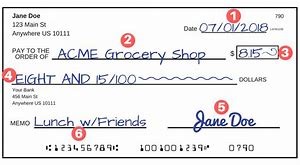
example


  1. Date line: date goes here
  2. Name of the writer of the check aka the payee line
  3. Numerical value of the amount of the check aka courtesy box
  4. The hand written amount of the check aka the legal line
  5. Signature line: signature of the payee goes here
  6. Memo line: optional note (what the check is fore i.e. groceries, reimbursement etc.)


Using the check

You can make use of a check by signing the back of it aka endorsing the check

You have several types of endorsements

For deposit only- restrictive

The name of the payee- blank

Pay to the order of – special endorsement


Dos and don’ts

Do make sure that the legal line and the courtesy box amounts match (a check wrote for $100 on the courtesy box must match the legal line amount. If a check is wrote for $10 on the legal line but in the courtesy box it looks wrote for $100 it must be taken for the LEGAL LINE amount of $10


Do sign your check at the place you intend to deposit or cash because if you lose it another person can endorse their name under yours and use the check (unless it is a special endorsement where it has to be pay to the order of a specific person)


Don’t write in different types/color of pen on the face of the check. That will alter the check and can cause the check to be refused

Do not write a check for “cash” if it is lost it can be used to be cashed by anyone

Make sure you have a signature under the signature line from the person writing the check otherwise it will not be utilized

Do not leave your checks out in the open because they have your account and routing number info there. Keep them in a safe place for storage.

Keep in mind that a check can be placed on hold if deposited or cashed depending on the institution or if put into an ATM

Do keep a consistent signature on your checks because signature fraud happens

Do get duplicate style checks; the carbon copy underneath the check will make balancing your check book easier

Do make sure you don’t damage your check in any way especially near the numbers at the bottom of the check because it will make using it harder

Do always write a check with a pen so no one can alter it

Do not leave your checks blank (not filling out a payee line) because it increases the risk of fraud with the check

Do make sure to balance your checkbook regularly to avoid discrepancies and running the risk of bouncing a check


With this you know have the basics of how to use a personal check. Stay tuned for other tips and tricks on navigating the fun world of personal finance


Photocredit: the balance.com