Taking a time to take a time out

Here’s a cup of chill for your chill pill

Life moves fast. We’re constantly on the go and it is always a steady hustle and bustle. We as a society are busy to the point of it gets stressful to keep firing on all cylinders. One thing that is neglected often is the importance of having time to take off from our busy plates and take the time to recalibrate and rest.

As someone who is a self professed workaholic, i am an advocate of taking some time for a vacation or even a personal day to just unwind from being always “on”. There many benefits to being able to take some time for yourself especially for your career. Taking a personal day/vacation time is important for a healthy work life balance. Once you take some time off from what you have focused so much of your time and energy on you’ll find yourself psychologically refreshed , improved focus, overall better balance between work and life. You will also notice that you’ll have time to catch up on things you might not have had time for when you didn’t before and even time to enjoy things you normally don’t such as a hobby or time with loved ones. You don’t need to have a two week retreat to tahiti necessarily (though if you want to do that I say go for it!). Even if you take a personal day per month or a leave for specific purposes like our friends in the uk. You will be able to find a better balance and it will help you in your longevity and satisfaction in your career.

The workforce is changing and according to a study the work day has lengthened and people are taking less breaks making it harder to find balance. Did you know in 2018 768 million vacation days were left unused? That is a lot of unused pto that is lost if it’s not rolled over or cashed out. Some occupations lack paid time off which forces workers to miss pay if they are not present. We know making money is important but we are human and we have other obligations outside of our career such as family, friends, hobbies and interest and our own sanity. Our constantly bustling culture is making us lose our sense of self and lose sight of things we enjoy. If left unchecked there are consequences from our health, relationships and overall career satisfaction and performance (burnout, health issues, poor performance etc)

Taking time off is an often neglected part of our busybody culture. We need to place more emphasis on taking time to step away to refocus and recalibrate for the sake of longevity and satisfaction in terms of one’s career. For those that do not offer pto i encourage a way to find a way to make them happen and for those that do not take a personal day or vacation to take one. It will do wonders for you. Until the next time my friends excelsior!

Opinion: The Retail Investors vs the hedge funds (the short squeeze)

Wallstreetbets a popular reddit forum

In my years of studying/working in finance, I’ve seen a few things but never as eventful as this. From what started as a far fetched speculation of GameStop shares going up to the discussion on Reddit forum r/wallstreetbets about an impending short on the gaming retail store, has evolved into one of the most interesting topics I’ve read all month. In the span of a month retail traders, billionaires, celebrities, and people in overseas markets have joined in on the events transpiring. If you would have asked me if GameStop would have hit $400 a share I would have thought that was a great joke but here we are in a time where GME stock was over $400 a share last week. The sheer leaps this stock has taken in a month have been mind-blowing and has been a part of some feedback, both positive and negative. From the media slamming those involved as “unsophisticated investors” who manipulated the market (while trading platforms such as Robinhood have blocked new shares from being bought which one would consider manipulation) to those that just like the stock and see the potential for the retailer to grow with the new console releases and acquisition of new talent on their team.

As an investor myself, I am a firm believer in letting people trade to their heart’s content. It’s a risk that most everyone involved should already know. It’s speculative and volatile and for the paper-thin arguments for platform restriction on stocks like GME, AMC and others are blatant manipulation to protect hedge funds from losses but also the media slanting is heavily skewed against the retail investors who have been apart of this. Needless to say, there are talks of class action lawsuits against Robinhood for restrictions on trade and it will not be the last I suspect. I suspect this time to be a transfer of generational wealth and people are missing the good people have been doing with their newfound wealth. If you get you to give. And that is what is happening here. I say let them trade. My only other word of wisdom with this is doing your homework and don’t just get on the bandwagon for the kicks and giggles. This is a great time to witness history and I cannot wait to see the final chapter in this saga. As always my friends invest responsibly and stay safe out there. Excelsior.

A year in review

Goodbye 2020 Funny Illustration - Vector Download
Photo credit Vexels

As this year comes to a close let’s look back at the past year. Look at the world around us and the current circumstances. Look at your situation. Look at the road ahead. We live in an uncertain time with a plethora of things that can happen. Life comes hard and fast, but we cannot let things that are important to slip by in the rapidly accelerating stream of time. Things such as family and friends, your goals and dreams, your finances and future.

This year I made several posts on personal finance, taking a departure from personal development topics, in an attempt to raise awareness and education on financial topics that are often not taught and/or oftentimes neglected. Personal finance is an important topic that is not meant to be taken lightly. It is something that has been in our past, working in our present and shaping our future. This year I have shared my expertise and knowledge of finance from my education and expertise working in the finance sector for the past few years now.

I encourage you, dear reader, to read my past posts on personal finance if you have not already. These are very insightful topics that will help with gaining more understanding on this topic. It has been a delight to bring such material to a wider audience and gain more readers. I will be uploading more regular content in the upcoming year for personal finance as well as bringing back more personal development content for your reading pleasure.

Before this year draws to a close, I will share one last lesson for the year. And that is the importance of the emergency fund. In a previous post of mine, I mentioned the importance of establishing emergency savings. This year is the prime example of why everyone can benefit from an emergency fund. If one would not believe me look at the current state that we are in as a country and as a civilization worldwide. We live in an uncertain time and we must make decisions and investments and goals to help us out when we need it the most. From your insurance to your warranty, to your very own shoebox under the mattress if need be. Everyone needs their ace in hand at the ready because you will never know when it is time to use it. Stay healthy and safe dear reader. Happy holidays and I wish you a happy new year. Here is to a better year and a better road ahead through taking control of one’s financial future. Excelsior!

Collect call

What Happens If You Don't Pay a Debt Collection

Dealing with credit can be tricky, there are different types of factors that build your credit and factors that hurt it. One such factor that hurts your score is having collections out against you. Collections are oftentimes neglected and can come back around in the future.Did you know that 71 million Americans have collection debt of some sort or another? (courtesy of urban.org)

Collections come from when a loan or bill has gone unpaid or was charged off/ listed as a loss on a company’s profit and loss statement and is given over to a collection agency. The collection agency then goes to contact you to collect the debt to be paid off. Once the collection is paid then it is cleared from the book of the collection agency and is reflected on your credit report if it is paid off. The same applies if a bill is listed as a collection on your credit report.

In my field of expertise, I have come to know that letting collections sit is not conducive to a healthy credit rating and can serve as an annoying anchor weight stopping your credit from reaching new heights. It is imperative to get rid of collections as soon as they are discovered or If something is going towards collections. Even if a bill disappears somehow and it was not paid there could be a chance it was sent to a collection agency to pester you to get their payment. These are not to be taken lightly. Even if a collection is paid it remains on a credit report for seven years but despite this, it could show that it was paid and prevent a collection agency from bothering you about the same debt. This is because a collection agency has seven years to collect this debt before they lose their chance to get paid. If it is coming down to the wire the collection agency can sell this debt to another agency and the “doctor’s bill from 10 years ago” could be lurking around for the next 20 years! Like dirt under a rug, it is waiting to be disturbed and make a mess again.

Collections can hurt your FICO credit score, contrary to a commonly held belief I have come across in my time in the field and research. The claim is that when updated from “unpaid” to “paid,” the collection can appear to the scoring formula as having originated more recently than it did, which, if true, could lower the score. However, the “assigned” date on the credit report does not change when the collection status is updated, nor do the credit scoring formulas give fewer points for a paid than an unpaid collection. Due to the length of time since the debt was assigned to a collection agency weighs so heavily on a credit score, the removal of the most recent collections can often be expected to raise a score. On the other hand, if there are multiple collections and it’s the older ones that you’re able to get removed, such as via a “pay for delete,” you may not see any improvement in your score following the removal of these older collections. So there is no evidence to support the myth that paying a collection can lower a score.

Collections can happen to anyone, whether you are already managing your credit responsibly or have hit hard times financially. Separating the facts from the fallacies about collections and credit scores can help you make more of the right moves and avoid some of the bad ones that can have an undesirable result. One way to check on the impact a collection might be having on your credit is to obtain your credit report from your bank, credit union, or from even the bureaus themselves. You can also go to sites like annualcreditreport.com to get your report for free as well. Do not let collections sneak up on you, something that might seem insignificant can still have an impact in the long run. Until the next time friends, excelsior!  

In your best interest

Interest Rate Definition

You hear about it, you probably pay it, you probably get paid in it. Love it or hate it we are going to talk about interest, what it is and how to make sense of it. Interest is a simple concept but there is often misconceptions about it and confusion. Let us get started in debunking that confusion.

Interest is payment from a borrower or deposit taking institution (such as a bank) to either a lender (someone who you took out a loan from) or a depositor (someone who puts money in the bank) above the principal sum (the original amount of the loan or deposit).at a particular rate. It’s not like a fee which gets paid to a lender and it is not like a dividend that is paid to a shareholder. When interest is paid to a lender or a person depositing money in an interest-bearing account more money comes out on the principal balance. The rate of interest  is equal to the interest amount paid or received over a particular period divided by the principal sum borrowed or lent usually expressed by a percentage (such as the annual percentage rate for loans or average percentage yield on interest bearing savings). Wen dealing with interest you also have compound interest (this is the fun one to get paid but not so fun if you are the one paying) which makes the total amount of the debt grow. Interest can be compounded daily, monthly, or on a yearly basis and the impact is affected by the compounding rate.

When dealing with interest you have some rules of thumb to consider. First, the rule of 78s which helps with calculating interest during the life of the loan as you pay on it. (i.e. on a 1 year loan in the 1st month 12/78 of all interest owed over the life of the loan is due and so on and so forth until the 12th month where only 1/78 of all interest is due. The rule of 72 can be used to approximate how long it would take for money to double at a given interest rate, for the compounding interest to reach or exceed the initial deposit, divide 72 by the percentage interest rate. When dealing with interest you always have options to refinance as well as find interest bearing accounts for higher interest to be paid. There are more technical aspects to interest as one looks into the markets and economics outside of the simple aspects of getting pair or paying interest but that is a topic for another time.

Until the next time, stay safe and continue to learn. Excelscior!

Evaluating the current estate of affairs

Estate of the Union (@EstateOtheUnion) | Twitter

I am not the type to wax political but given the upcoming election and this topic I could not resist this title of the article and photo. All jokes aside, the title of my final entry in the “legacy of your pocketbook” series will cover the topic of estates. You might have heard the term “estate sale” and may have bought some things from there (I know I certainly have), but what is an estate and how does it function?

An Estate, in laymen’s terms, is everything comprising the net worth of an individual. These things could include things such as land and real estate, possessions, financial securities, cash and any other assets that a person owns or has controlling interest in; basically, anything they own.  The value of an estate typically shows up in two instances: when the person with an estate declares bankruptcy and when that person passes away. When declaring bankruptcy, the assets in the estate are looked at to judge which debts outstanding will be reasonably expected to be paid on. The legal process involved is rigorous. Estates are most relevant when a person dies. Prior to this there may be estate planning that takes place. Planning the estate is simply managing the division and inheritance of the persons estate and planning the financial aspects of a person’s life. Generally speaking, a personal draws up a will which explains the individual’s intent on dividing up the estate upon death (otherwise known as a beneficiary).

Estates are, in almost all cases, divided among the deceased’s family. This tends to keep wealth within the family for generations after the fact. An inheritance tends to account for a massive proportion of total wealth in the US and around the world and is in part responsible for income inequality (in addition to other factors). Despite this there is an inheritance/ estate tax on the estate and assets could sometimes be required to be sold to help pay on these taxes imposed on beneficiaries. It is also advisable for people with estates to consult an estate attorney to aid in navigating the complex world of estate law (the same applies to trusts as well).

Estates can be a daunting topic to delve into but with an understanding of what an estate is and how it works (and some sound legal counsel) it does not have to be. That is all I have for now in this “legacy of your pocketbook” series. Until the next time dear reader excelsior!

Trust funds baby!

Trust - Should I create one? A NYC Guide - Regina Kiperman, RK Law PC

In my last post on estate planning, I discussed what a beneficiary was and what it does. This time I will continue with my series on personal finance in regard to another topic when it comes to future planning. We often hear the term trusts, trust funds, and maybe even the term “trust fund baby”; what exactly is a trust? Let’s explore what a trust is and what it does. I’m also going to be using more of the legal definition with some paraphrasing along with some links for certain terms for easier reading.

A trust, per the diction definition, is a fiduciary relationship in which one party, known as a trustor, gives another party, the trustee, the right to hold title to property or assets for the benefit of a third party, the beneficiary. Trusts are established to provide legal protection for the trustor’s assets, to make sure those assets are distributed according to the wishes of the trustor, and to save time, reduce paperwork and, in some cases, avoid or reduce inheritance or estate taxes.

Trusts are created by settlors (an individual along with their lawyer) who decide how to transfer parts or all of their assets to trustees. These trustees hold on to the assets for the beneficiaries of the trust. The rules of a trust depend on the terms on which it was built. In some areas, it is possible for older beneficiaries to become trustees. For example, in some jurisdictions, the grantor can be a lifetime beneficiary and a trustee at the same time.

A trust can be used to determine how a person’s money should be managed and distributed while that person is alive, or after their death. A trust helps avoid taxes and probate. It can protect assets from creditors, and it can dictate the terms of an inheritance for beneficiaries. The disadvantages of trusts are that they require time and money to create, and they cannot be easily revoked.

There are several different kinds of trusts: living trusts which distribute assets while a person is alive and transfer to beneficiaries upon death. Revocable trusts can be changed during the trustor during their lifetime. Irrevocable trusts are unable to be changed once set even if the trustor is still alive and after death. Depending on a person’s needs a trust can be set up however they wish. Trusts have many purposes: privacy for distribution of assets, estate planning, tax planning, and the list goes on.

And there you have it dear readers, a quick and simple explanation of what trusts are and different things they do. I hope this abridged walkthrough sheds more light on a complicated topic. Until the next time dear reader, excelsior!

Opinion: Respecting our fellow human

just-my-two-cents | ...feel free to add any comment ...

This month I will be taking a break from the usual personal and professional development material to discuss a prevalent topic during these peculiar times. It has occurred to me based on what has been in the news, the radio, and the internet that there are a lot of things going on that have been rather stressful, aggravating, and just downright infuriating. From the #speakingout movement to the #blacklivesmatter movement that has been going on for some time, and even wearing a mask during the ongoing pandemic. One key factor that these events revolve around is the fact that there is a lack of respect in the world for our fellow man, woman, and children

There are people who disregard others lack of interest in their romantic advances to the point of where it causes others to resort to vile behavior and causing virtually irreparable harm to another physically, mentally or spiritually. There are those that work in law enforcement who disrespect minorities and treat them with unnecessary severity. There are those that say things that are uncouth about their political rivals and those who simply lack empathy for their fellow human. I Have discussed this topic in a presentation earlier this week and it rings clear. It is time that we as a people exercise more respect and empathy and learn a willingness to help those around us.

We need to recognize that if all status and recognition and money in the world were taken away at the end of the day, we all bleed the same blood. We are at a time where it is important to come together and work together. Let us learn to respect one another as well as ourselves in order to make life, especially in these times, a little more bearable. That is my two cents on the matter. let’s all do better and do our best for the future. Excelsior!

Beneficiaries: Assigning your money to infinity from beyond

What Is a Beneficiary and How Do I Choose One? | DaveRamsey.com

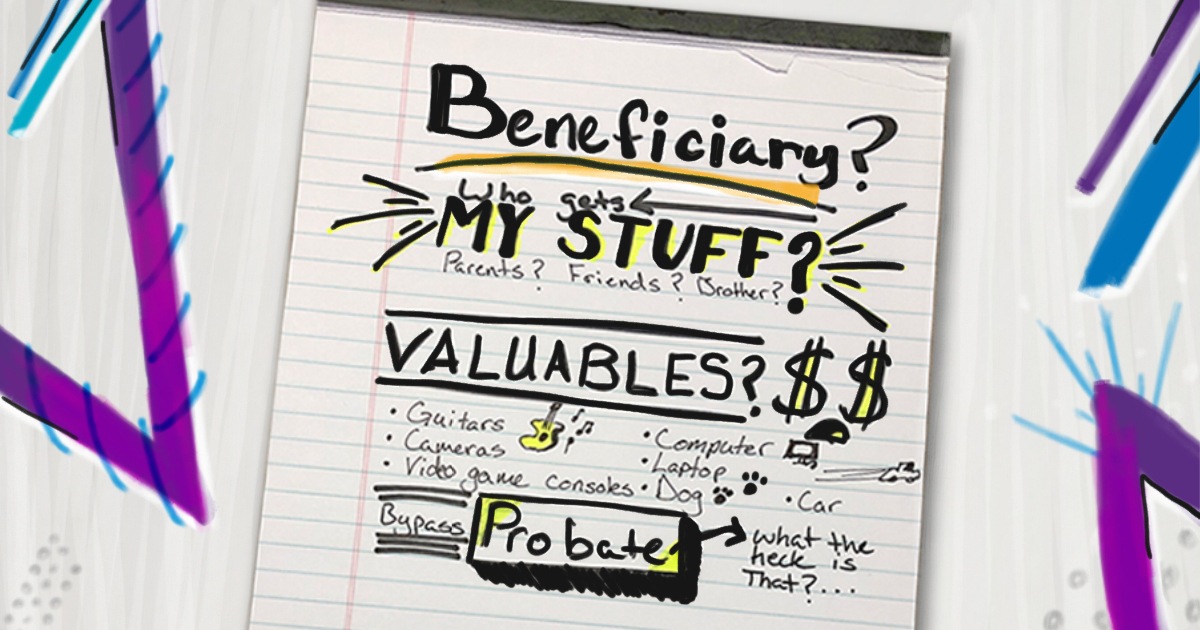
In my few years in my banking career I have seen many things but one thing that breaks my heart it is seeing someone without a beneficiary for their funds. This simple step can lead you to avoiding months if not years of hassle with the courts (or even court costs if necessary). It is relatively simple process that I preach on constantly whenever I see it, so get ready for me to get back on my soap box once again.

Intellectual Property: Don't Forget to Cover Your (Other) Assets ...

During this trying time, bank accounts, insurance accounts, brokerage accounts, retirement accounts, you name it. The sheer number of financial institutions that count us as customers may seem staggering and in the rush to open an account, we may have forgotten to add a beneficiary, or even simply postponed that last little detail until it was more convenient (or maybe someone hasn’t thought of one yet). Simply taking the time to ask about it, either you or the agent, will help move the conversation in the right direction for several reasons.

The first reason is that you want to make sure you want the people of your choosing to inherit your money. The person you can list can be a spouse, a child, a relative you trust, or even your trust (we’ll come back to that later don’t you worry). By naming your beneficiaries, you ensure that your money goes where you intend for it to go. That could be to a relative who really needs the financial assistance, a charity that’s close to your heart or whomever you want the money directed to. Without clear directions as to your wishes, executors or the state will follow only what the law says in distributing your assets and that’s not fun. You can name as many beneficiaries as necessary to split the proceeds as well if you would like as well. But do keep in mind if a beneficiary passes or any circumstance arise to compromise the beneficiary that these can be changed in most cases. This way everyone can speed up the probate process (because probate court is not a fun time for your family or the financial institutions reporting process) in addition there’s less going to a court appointed estate to be taken care of.

Legacy Planning Advisors, Inc.

The second reason is being able to update it on an annual basis. If you’re married, you can almost always change the beneficiary of your accounts without your spouse’s permission. In fact, this is one of the first recommendations I make in a divorce process. The worst that can happen is being forced to put the beneficiary designation back to the previous spouse if ordered by the court or other arrangements. You can change a beneficiary so make sure to periodically check to see if you have a beneficiary listed or if you need to change or add one (my recommendation is once a year or every six months if needed.) This will help for several reasons: 1) it keeps your information up to date 2) you can also use this way to limit family fighting over your assets once you’re gone. 3) Beneficiaries trump wills as well, so make sure you plan accordingly. (contact your estate planer regarding this to make sure things are done appropriately.

 Naming a beneficiary is an easy thing to skip over when opening an account, but this small step can save a huge headache – and potentially a lot of money – later. So take an inventory of your financial accounts today, and ensure that your wishes are up to date. Then resolve to keep the accounts updated annually so that you continue to avoid problems for yourself and your heirs. During this time, I urge you now, more than ever. Please get your beneficiaries in order if you haven’t considered it before because we are all human and a simple two-minute process can help save your loved ones from a longer time trying to take care of your estate. Until the next time friends. Stay safe and healthy, Excelsior!

Taking a chill pill

8tracks radio | Take a chill pill! (25 songs) | free and music ...

We live in a rather stressful and uncertain time. There are a lot of things happening during this trying time in everyone’s life now. Here in the good old U S of A we are used to the hustle and bustle of daily life but now everything is on a pause. Now is an opportune time to talk about something that is never really taken seriously, rest, and taking a moment to slow down.

Right now many things have been put on pause: visits to your favorite pub, café or restaurant, going to get your reps at the gym (see my previous post on no gym fitness), and even seeing loved ones. There is some good to be found during this time of uncertainty. People are getting creative in terms of cooking abilities, video parties with friends, and even finding ways to still stay in shape. It’s also important to use this time to spend it with our loved ones (even if you have to facetime or conference call them) and also take a moment to rest and take a moment to just recalibrate for when things go back to normal.

Our society has been defined by consistently being on the move. We’re running to meetings, conference calls, fundraisers, recitals, work, you name it. We never take the time anymore to stop and enjoy the smell of the flowers or the warmth of the sun. We see it and know it’s there but do not actually bask in it to truly appreciate it. Our constant hustle and shuffle keeps us from our things that matter most to us (you know what those are), enjoying small moments in life that we take for granted (like breathing clean air, the taste of the morning coffee you chug down without taking a moment to enjoy the smell and taste of it, or the feeling of the wind in your hair…or scalp. We’re always busy or busy bragging to the point where the word busy has become trite and bland.

During this time connect with your loved ones. Call up your grade school pals, learn how to perfect your homemade bread recipe, enjoy the taste of your favorite dessert and the sensation of the wind in your face if you go sailing/biking (since we can do that now in Michigan). Enjoy the moment to turn this lemon into lemonade. Take the time out to take the time and enjoy it as best you can.

During this time of uncertainty, take a moment to take a breath and make this rough period of time to recalibrate and enjoy the finer details of life and use the extra time to get creative and even learn new things. Let’s come out of this quarantine and period of uncertainty smarter, stronger, have more expanded skills, and become more cognizant of the need to take a moment to breathe.  Until the next time my friends, stay safe and healthy and Excelsior.