The wonderful world of refinancing

In the current landscape, refinancing is a useful tool for one’s financial journey. People refinance for a variety of reasons.  Many things such as home loans, car loans, student and personal loans can be refinanced. Let us look at what all goes into a refinance.

A refinance, or “refi” for short, refers to the process of revising and replacing the terms of an existing credit agreement, usually as it relates to a loan or mortgage. When a business or an individual decides to refinance a credit obligation, they effectively seek to make favorable changes to their interest rate, payment schedule, and/or other terms outlined in their contract. If approved, the borrower gets a new contract that takes the place of the original agreement. Borrowers often choose to refinance when the interest-rate environment changes substantially, causing potential savings on debt payments from a new agreement.

Consumers generally seek to refinance certain debt obligations in order to obtain more favorable borrowing terms, often in response to shifting economic conditions. Common goals from refinancing are to lower one’s fixed interest rate to reduce payments over the life of the loan, to change the duration of the loan, or to switch from a fixed-rate mortgage to an adjustable-rate mortgage (ARM) or vice versa (in regard to mortgages in particular). Note that during a refinance of a consumer loan (auto, personal, etc.) there are typically no closing costs associated with the refinance process unlike most mortgage loans

Borrowers may also refinance because their credit profile has improved, because of changes made to their long-term financial plans, or to pay off their existing debts by consolidating them into one low-priced loan. Changing interest rates in the economy are moving factors that people look for when shopping around for places to refinance. There must be a new or existing loan for there to be a refinance.

There are several types of refinancing one could take advantage of for their financial situation. One such refinance is a rate/term refinance for a better rate and a more advantageous term for repayment. Another is a cash-out refinance when your auto has more value (commonly referred to as loan to value or LTV) to pull a certain amount of funding against the worth of the vehicle. Another is a cash-in refinance where an individual can place money down to get to their ideal payment, rate, or term. Lastly, one could go for a debt consolidation refinance to help put their payments under one roof and one easy payment.

There are many benefits to a refinance such as lower payments, rates, and terms. Additionally, there is the convenience of consolidation of payments and an influx of cash for cash-out refinancing requests. There are some drawbacks to a refinance. One such drawback is if there is a movement back to the original term there is more interest to be paid during the life of the loan, shortened terms may increase payment potentially as well. If interest rates drop, you won’t get the benefit with a fixed-rate mortgage unless you refinance again and you could lose equity in your home depending on the mortgage refinance.

Refinancing is a powerful tool that can benefit you in the long run if done correctly. During my time in finance, I have seen many practical applications of refinancing that people use to their advantage. Until the next time dear readers, excelsior!

How sufficient is your credit?

A message on a credit report that can pop up is “insufficient credit”. This is a message commonly found for those who are young, operated primarily with buying things cash, or perhaps haven’t taken out a form of credit in a very long time. This isn’t necessarily a good or bad thing, but rather a good launching point towards developing health credit.

When applying for credit, lenders are only allowed to use a specific set of criteria to evaluate an application. Insufficient credit history indicates that the applicant doesn’t have enough accounts with a long enough payment history to approve an application. Banks, cell phone companies, and utility companies also look at this information when you set up a new account. As an applicant applies for bigger loans, lenders want to see that an applicant can handle multiple accounts responsibly. If someone only has a single credit card or too few accounts overall this could be a reason for rejection on a credit application.

On the other side of the coin, one wouldn’t want to go opening too many new accounts in a short time to build credit. On average it takes a minimum of 6 months for a new trade to make progress on an individual’s credit rating. Opening too many would be classified as an escalation of new debt. This could also be a reason to deny an applicant on a credit application. On another note, if there isn’t an update in activity (such as a credit limit increase or a new line of credit) for a substantial period, an individual’s credit could become stale and outdated causing it to be insufficient again. Keep in mind that the age of active credit lines also helps in building a score over time. These trades could be a line of credit or a credit card primarily.

Updating the personal information in one’s credit history is relatively easy. Building up one’s credit history takes more time and credit experts emphasize that there is no quick fix to a credit score. Experts typically recommend a few ways to help keep things in a positive light for one’s credit: 1) pay all bills on time to avoid them going into a collection action 2) opening a secured credit card or secure loan of some sort to start a history 3) reporting non-debt obligations If your lender uses a scoring system that counts that among other ways. Some lenders will overlook an insufficient credit history if the applicant is strong in other areas such as in debt-to-income ratios and stable proof of income to show how one could make payments.

Keep in mind that another common misconception is that checking accounts, debit cards and credit union accounts do not build credit. The checking account is designated for expenses and the debit card can be run as “credit” but is not truly linked to a credit line. Credit union accounts give you access to the credit union and all its services such as lending and credit building programs.   

Having insufficient credit can be difficult and confusing at times, but it doesn’t have to be. Feel free to reach out to your local financial experts at your financial institution and ask for ways to help establish a credit history for yourself. It will take time but the result of a healthy score and better rates are worth it. Until the next time dear readers, excelsior!
Debt vs income part 2: the less secure edition

Last time we discussed what the debt to income ratio was and how it effects one’s overall financial picture. This time we will discuss another ratio that effects your financial picture. The unsecured debt to income ratio is another important piece to understand your financial situation.

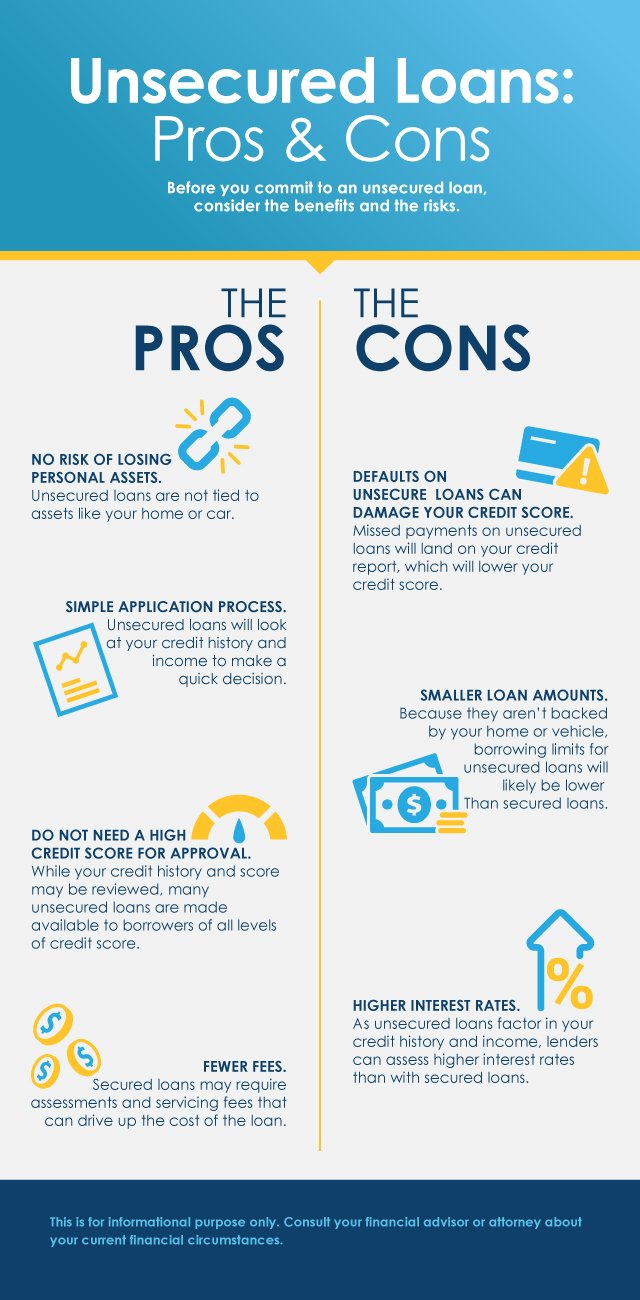
Unsecured debt is different from a secured debt as the debt isn’t tied to a piece of collateral such as a car or house. Types of unsecured debt would be credit cards, personal loans, lines of credit, etc. As such these debts are typically assessed higher interest rates than secured debt because of the risks associated with them in the event of a default of payment from a borrower or bankruptcy risk if the borrower ventured into this route.

The unsecured debt ratio (UDTI) equals the total of unsecured debt divided by the total annual income, multiplied by 100, which converts it to a percentage. For example, say Sarah carries $8,000 of credit card debt, $12,000 in personal loans and her annual income is $80,000. Divide the total unsecured debt of $20,000 by $80,000 to get 0.25. Then, multiply 0.25 by 100 to find that Sarah has an unsecured ratio is 25 percent. If Sarah increases her unsecured debt load her and her income remains the same her UDTI will increase. In the opposite scenario if Sarah’s income increases or her unsecured debt is paid down more her UDTI decreases.

Lenders don’t like to make additional unsecured loans to people with high existing unsecured ratios because that’s tacking on additional debt to someone who’s already overextended. Financial institutions often see unsecured ratios of above about 20% as potentially dangerous. When someone gets above 20 percent, the prospective lender might lower the amount it will lend or require the borrower to put up collateral. If the borrower exceeds 30 percent, they will likely encounter trouble just getting an unsecured loan, because lenders are concerned with the ability to repay and there is more risk associated with lending unsecured vs secured. It is ideal to be in a range that is reasonable for a borrowers existing debt and income level and to go beyond that could indicated many factors such as living off of credit cards and unsecured debt to a point where eventually it leads to an eventual endpoint of defaults, garnishments or legal actions to recoup losses from a borrower or even bankruptcy filled by a borrower who is unable to pay. None of which are a desirable outcome for the institution or the borrow to end up.

The unsecured debt to income ratio is an important snapshot of one’s financial picture in the eyes of a lender. It is important to know how it can help or hurt your overall credit and financial situation. I have included a link to assist in calculating your unsecured debt to income ratio as well. Please uses these tools to help with understanding where you are with your own debts to gain a firm grasp on what was covered today. Until the next time dear reader. Excelsior!

Debts vs income

From a credit perspective any things can be weighed in to determine how a lender can look at to determine eligibility for a loan. One such variable is what is called the debt-to-income ratio. This ratio is something that can determine your inflow vs outflow of money that you use for paying any debtor.

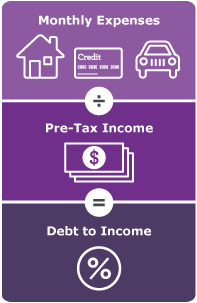
The debt-to-income ratio (commonly referred to as DTI ratio for short) is the percentage of your gross monthly income that goes to paying your monthly debt payments and is used by lenders to determine your borrowing risk. A low DTI ratio demonstrates a good balance between debt and income, while a higher ratio determines there is more going on behind the scenes.  The maximum DTI ratio varies from lender to lender. However, the lower the debt-to-income ratio, the better the chances that the borrower will be approved, or at least considered, for the credit application.  An ideal formula for determining DTI would be to divide the number of the total monthly debt payments (credit cards, loans, mortgages, rent etc.) over the total of gross monthly income (your income before tax and deductions). For example, if john owes $1200 in his monthly bills and his gross income is $2700 per month his overall DTI would be $1200/2700=0.44 or 44%. John has a more moderate debt to income ratio based on these figures.

Calculate Your Debt-to-Income Ratio – Wells Fargo

One can lower their debt-to-income ratio by reducing their monthly recurring debt or increasing their gross monthly income. Using the above example, if John has the same recurring monthly debt of $2,000 but his gross monthly income increases to $8,000, his DTI ratio calculation will change to $2,000/$8,000 for a debt-to-income ratio of 0.25 or 25%. Similarly, if John’s income stays the same at $6,000, but he can pay off his car loan, his monthly recurring debt payments would fall to $1,500 since the car payment was $500 per month. John’s DTI ratio would be calculated as $1,500/$6,000 = 0.25 or 25%. If John can both reduce his monthly debt payments to $1,500 and increase his gross monthly income to $8,000, his DTI ratio would be calculated as $1,500/$8,000, which equals 0.1875 or 18.75%. Ideally renegotiating interest rates, aggressive payment schedules including principal payments and generating more income through a second job or a side gig for other active or passive income are some ways that people have taken to rapidly clear up debt and improve their ratios

The DTI calculation in assessing the risk that a borrower poses to a lender in terms of their ability to repay. The lower their ratio (such as 35% or less as noted by an average between different lending companies and financial institutions) can be considered more favorable. Meanwhile a DTI of 36-49% leaves room for improvement and can be steered into a more manageable direction with proper education and action plans. For a DTI above 50% it is generally considered difficult for a borrower or spend or save as their money for unforeseen circumstances. The higher the DTI the more likely a borrower could be inversely impacted by any major financial event and presents more of a risk of default to a lender. The ideal situation for a customer and a lender is to be at a point where any new debt ought not to put the borrower or the organization doing the lending in an adverse situation that would harm the institution with a loss or damage an individual’s credit.

The Debt-to-income ratio is a commonly questioned concept for credit building and lending by consumers. I hope my summary of what DTI is and how it affects you will give you more insight to how to further gain more perspective on your own credit journey. For your convenience I have also included a link for a DTI calculator for you to plug and play with figures to see how your own DTI is faring. Until the next time dear readers. Excelsior!

Credit utilization

A common tactic utilized to build a credit history is typically acquiring a credit card of some sort. this along with other credit building programs begins one’s journey for getting into a more favorable credit range. Credit card usage is a factor that helps with establishing a score, but there are things about the usage that one must know.

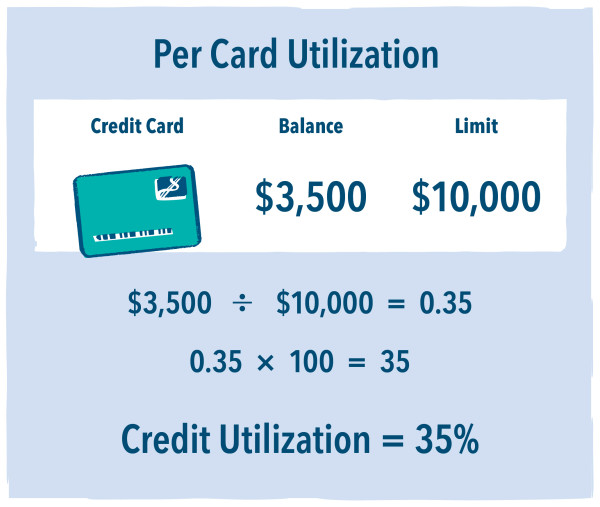
A credit card is a revolving tradeline (a trade line that when it is used and repaid you acquire a certain amount of the credit back). Credit cards have a capacity of use that displays how much of the overall limit has been used in a specific period. Credit utilization measures the balances you owe on your credit cards relative to the cards’ credit limits. If you never use your credit cards and there’s no balance on them, your credit utilization would be zero. If you typically carry a balance on one or more cards, you are ‘utilizing’ some of your available credit and credit score providers will take note. Credit utilization is a key piece of your credit score puzzle. Both FICO and Vantage, two big credit scoring agencies, list credit utilization as the second highest factor they consider when determining credit score. If your utilization ratio is high, it indicates that you may be overspending and that can negatively impact your score. This utilization ratio, as a rule of thumb, is recommended to be around 30 percent or less and is calculated by the total amount of card balances vs the amount of available credit. This means not maxing out existing credit cards. This utilization ratio can be improved by a variety of methods including, but not limited to; paying down current debt past the minimum payment, consolidation of credit card debts, getting another credit card, getting a credit limit increase, or leaving open existing cards once they’re paid amongst other methods.

How Does Credit Utilization Work?

Now that you know how to improve your credit utilization, it’s important to keep track of your progress. Check your credit card balances monthly and keep tabs on your utilization ratios. Many card issuers offer balance alerts via text or email, making it even easier to prevent your utilization ratio from creeping up. Monitoring your credit score can also provide motivation to keep your utilization in check. This was a short lesson, but vital nonetheless. Until the next time dear reader. Excelsior!

Inquiring minds would like to know

The Difference Between Hard and Soft Credit Inquiries - Rich Money

Credit is a topic that has several different facets that make it up. One factor that makes up a credit score (as much as 10 percent) is an inquiry. An inquiry is the beginning stage of beginning a new line of credit and shows how one is looking to seek a new line of credit.

A credit inquiry is a request by an institution for credit report information from a credit-reporting agency. Credit inquiries can be from all types of entities for various reasons, but they are typically made by financial institutions. They are classified as either a hard inquiry or a soft inquiry. Hard inquiries are a key part of the underwriting process for all types of credit. Soft inquiries help credit companies to market their products and can be used to help consumers and are good for reviewing with customers/clients.

Hard inquiries are requested from a credit bureau whenever a borrower completes a new credit application. They are retrieved using a customer’s Social Security number and are required for the credit underwriting process. Hard inquiries provide a creditor with a full credit report on a borrower. This report will include a borrower’s credit and details on their credit history. These are typically displayed on a credit report for approximately 24 months before falling off. Hard inquiries can be harmful to a borrower’s credit score. Each hard inquiry usually causes a small credit score to decrease for a borrower. Hard inquiries remain on one’s credit report for two years. Generally, a high number of hard credit inquiries in a short period of time can be interpreted as an attempt to substantially expand available credit, which creates higher risks for a lender. Hard inquiries can be harmful to a borrower’s credit score. Each hard inquiry usually causes a small credit score to decrease for a borrower. Hard inquiries remain on one’s credit report for two years. Generally, a high number of hard credit inquiries in a short period of time can be interpreted as an attempt to substantially expand available credit, which creates higher risks for a lender, usually within a window of 14-45 days. For those unable or unwilling to wait two years and who are comfortable paying a small fee, one of the best credit repair companies might be able to get the hard inquiries removed from a credit report sooner. In some instances, hard inquiries also may be used for situations other than a credit application. An employment background check and a lease rental application are two instances in which a hard inquiry also may be required. In some instances, hard inquiries also may be used for situations other than a credit application. An employment background check and a lease rental application are two instances in which a hard inquiry also may be required.

Soft inquiries are not included in a credit report. These inquiries can be requested for a variety of reasons. Credit companies have relationships with credit bureaus for soft inquiries that result in marketing lists for potential customers. These soft inquiries are customized by the credit company to identify borrowers who meet some of their underwriting characteristics for a loan. Credit-aggregating services also use soft inquiries to help borrowers find a loan. These platforms require information about a borrower, including their Social Security number, which allows for soft inquiries and prequalification offers. Many lenders also will provide a borrower with quotes through a soft inquiry request that can help them understand potential loan terms. Personal credit reports are also obtained through soft inquiries. Individuals have a right to obtain free annual credit reports from credit reporting agencies that detail their credit information. Individuals can also sign up for free credit scores through their credit card companies. These credit scores are reported to borrowers each month and are obtained by the credit card company through a soft inquiry.

Inquiries are an indicator of what makes up a credit score as well as seeking out new credit. The small components that make up something that most people shy away from are an integral part of your overall credit score. Given this new information may you have a better understanding of how this helps in shaping your credit history for future purchases. Until the next time dear reader. Excelsior!

Challenges of the young professional

The workplace can be a difficult terrain to navigate for any and everyone. It does not matter if it is a blue collar construction job or a white collar administrator role. Every position and environment has their own challenges. Throw in a new batch of college or high school graduates into the mix and you have an interesting mix of dynamics in the work place. Being a young professional in the workplace myself, here are some first and second hand illustrations of potential challenges and how to get through them.

A common struggle is the matter of being discounted due to age. Everyone has a beginning and needs to learn but after a while, skills are obtained and innovations and insights are developed. For those who are young (or in some cases young looking) there is a need to take an extra step and work a little harder to establish credibility. You’re a seasoned, skilled professional with years of valuable experience under your belt. These tips can make sure all of those things shine through at work—even if your gray hair doesn’t.

Navigating the professional world can be a little tough so it is important to have a career plan and set yourself in the trajectory to reach your career goals via advocating for yourself and setting clear cut goals for yourself. Build your network and share your motivation with your manager/supervisor to help with crafting an action plan to get you where you want to be. Even if you’re starting your own business make sure to get connected and voice your aspirations with those who are and have been where you want to go.

Another important aspect in being a young professional is presenting yourself as such from your dress style, email and text etiquette, and how you communicate with others in a working capacity. That includes leaving the slang at the door during work hours because not everyone in the office is privy to the lexicon used on Instagram and other social media. Do not overconpensate by acting cocky but yet if you are skilled let it be on display in a way that doesn’t make you seem arrogant. And above all else be patient and humble and deliver constant results to show that despite your youthfulnes, you are a force to be reckoned with and the sky is the limit.

To the young and the young in heart I encourage you to use these principles and see how far they take you. Often times I hear “I’m/you’re too young/old” I am a believer that that is a crutch that is used to hold us back from your dreams. If a 20 year old can become a music producer and make over $160,000 a year, or a 80 year old pass the New York bar exam or start a business at 30 anything is possible. It all depends on the willingness to make things happen and the hunger to not stop until the goal is met and when the goal is reached they exceed it! Until next time readers. Excelsior!

Motivated May: The Vergil Workout

For those that know me personally, I am an avid gamer and a fan of working out and maintaining my physical abilities. I came across two websites called superherojacked.com and beagamecharacter.com which had many of workouts inspired by different characters and celebrities alike. I took on some of the different workout programs to much success and decided to attempt a custom program of my own inspired by a character of my choosing. For this series I will be drawing inspiration from Vergil from the devil may cry series. Vergil is an accomplished swordsman and has incredible superhuman strength and agility, I decided to craft my series based on this premise. I took the approach of using body weight exercises to make it more realistic for a wandering swordsman character such as Vergil. This is a six day program but go at a pace that will work for you and also remember to warm up beforehand!

Strength training (5 sets of 5-20 reps depending on experience follow up with low intensity cardio of your choice)

Workout 1

Step up lunges (5 x 5-20 each time)

Triceps dips (5 x 5-20, using a set of chairs work well for this)

Door rows (5 x 5-20 each side)

Plank (5x 30 sec-1 min or more)

Arm circles (5 x 5-20 both directions)

Workout 2

Pike shoulder press (5x 5-20)

Chin-ups (5 x5-20)

Good mornings (5 x 5-20)

Sit-ups (5 x 10-20)

Hindu squats (5 x 5-20)

Incline/ decline pushups (5 x 5-20, I switched from incline to decline to mix things up a bit)

Workout 3

Pullups (5 x 5-20)

Alternating width pushups (5 x 5-20, I switched from wide grip to closed grip pushups for this)

Shoulder touch (5 x 5-20 each side)

High knees (5 x 10-40)

Hanging leg raises (5 x 5-20)

Cardio

In conjunction to the strength training Vergil has a lot of endurance and cardio for fighting for extended periods of time. For cardio I suggest going with a HIIT approach with these (for those who do not know what that is, it is simply engaging in high periods of activity with resting intervals)

Cardio 1

Jog/run (one and one intervals for a 5k length or build up to it depending on your experience level) 30 min

Cardio 2

Shadowboxing (1 min work with 30 seconds of rest between sets) 30 min

Plyometrics

Vergil has explosive powerful movements with his fists and his sword, so it is only right to combine the two of them together. I also use a steel club to build on forearm strength and shoulder mobility. Check out my paid link for a good starter club.

Burpee (3 x to failure)

Plyo pushups (3 x to failure)

Medicine ball toss (3 x to failure)

Club/hammer swings (3 x to failure)

Club/ hammer abdominal twists (3 x to failure)

After giving this series a try I felt much stronger after the fact. Train well in preparation for the summer months and in general. Excelsior!

As an Amazon affiliate, I earn from qualifying purchases.

A matter of the mind

In life you will come across different points of view on an argument, contrasting worldviews, and limiting beliefs that hold people back. What does this have to do with personal development you might ask? Simply put, looking at things from a different perspective and adapting a different mindset can help shape your way of thinking and how you adapt to changes or challenges presented in life

A prime example of how a mind set can help with priming you for success would be this video i came across in regards to one’s “inner game” and their ability to power through obstacles and get things done. Often times i hear things such as “i can’t” or ” i don’t know if i can” and my response is typically “yes you can” and “what makes you think you cant?” to challenge this limiting belief someone may have presented.

Limiting beliefs are things that can hold up back from where we need to be in life. Beliefs such as “I’m too young/old” i have an article that challenges that. “I don’t have the skill set or know how” there are hundreds of resources out there to educate yourself on different subject matters such as workshops, seminars and free classes for those who might pursue something without going for a degree. There are even websites like khan academy that are available for free for people to learn things such as coding, grammar, history etc. I am a firm believer of finding like minded people to collaborate ideas with to come up with innovative new ideas. Finding mentors to help you get to where you need to get to the next level of life and i strongly encourage finding one to help you push yourself to that level. Above all else, try and fail. You cannot learn without trial and error because when you have an error you can treat it as a learning experience to use for the next challenge. Do not be afraid to try for fear of failure but embrace it and treat mistakes and failures as something to use in obtaining wisdom for yourself those who follow after you.

The world is vastly changing in the digital age. There are more resources on the web, in person and even courses one could take to better a skill set or give people the starting tools for a new chapter in life. But it starts with having a mind to be open and willing to absorb the material required to get to the next level of success in your adventure of life. In my own experience I’ve trained with some of the best people in my position, took on some self study in my own time and above all took time and developed a system that works for me through trial and error to help me become a top producer in my position at work during my first few months. I had to challenge things i knew and didn’t know and learn from the best and find a way to take my game to the next level. Beforehand i had limiting beliefs that held me back on my overall workflow and production and once i obtained the training, self study, experience and getting a mentor I haven’t looked back since. Anyone can do it and so can you!

Challenging and changing one’s inner game is imperative to reaching the next level of success for whatever you are seeking to obtain in life. If you can change your mindset into what it needs to be to reach new heights you’ll find that those limiting beliefs are merely lead shoes that weigh you down. Remember change your mindset from limited to limit breaking and you will see results. Don’t wait what better time to start than right now. Excelsior!

Streams of flowing income

What is Multiple Streams of Internet Income (MSII)? Why is it important to  have MSII? – The Internet Income Academy

This time a year ago the entire world was turned upside down by a pandemic. Lockdowns ensued and people lost jobs, lives, and there was so much panic and confusion and uncertainty. Fast forward a year later and we are still feeling the effects of this ongoing issue in every way possible. One of the lessons that cannot be emphasized enough is the need for an alternative stream of income in the even one stream dries up there are others to keep funds flowing through into your accounts.

There are several different types of income, the first of which is the most common being earned income. We earn it by the hour, by the sale, by the project or by the salary. We get up most days to report to our employers to earn this income. The second type of income is profit income. When goods and services are sold there are costs associated. When businesses sell at a price higher than the cost incurred there is profit earned on the sale of the good or service. These are what are called active income streams because when one is trying to obtain income  they are actively pursuing it.

Another type of income earned is what is called passive income, this comes without action and money is made typically around the clock. One type of passive income is interest income from placing money in an interest-bearing account such as a high yield savings account or CD or any other interest-bearing products offered by your financial institution. (if you have not read my article on money market savings or CD accounts please refer to those articles for more information). Another passive income source is dividend income which comes from investments in stocks or bonds or mutual funds which pay out a dividend on a regular basis. This goes hand and hand alongside capital gains income from buying and selling assets can provide you with an income (you buy stocks and shares worth $100 and then sell them on for $120, the capital gain is $20.). Another passive income type is real estate income from the sale and renting of property to tenants and buyers. Lastly, royalty income from intellectual property such as books, film and music being sold or used by third parties. There are so many ways to make an alternative stream of income some big, small conventional or unique.

In light of this past year and the years to come, now more than ever, is this a time to keep an eye open for opportunities to obtain income. Diversification is useful in today’s times given the current state of the world. After reading this I hope this inspires you to open your mind to the different possibilities of generating income and maintaining a living in a way that works best for you. In the meantime, stay inspired and motivated. Excelscior!